


Dive leaders should foster an environment in which reporting symptoms is expected and supported, not stigmatized.

WHY EARLY REPORTING saves lives and reduces the likelihood of a lasting injury: In the recreational diving world, incidents rarely begin as emergencies, they begin as subtle or vague symptoms. A slight tingling in the hand. Unusual fatigue. Mild joint discomfort. A persistent cough after surfacing. Too often, these early warning signs go unreported, dismissed as insignificant or unrelated. For dive leaders and operators, this moment, when a diver decides whether or not to speak up, is where safety is either preserved or compromised.
Promoting early reporting of symptoms associated with diving-related injuries, including decompression sickness (DCS), arterial gas embolism (AGE), collectively referred to as Decompression Illness (DCI) and immersion pulmonary edema (IPE), is one of the most powerful and underutilized tools in risk management.
Despite decades of diver education and improved access to diving medicine and safety resources, delay in reporting post-dive symptoms remains a persistent and potentially consequential issue in recreational and professional diving. Early recognition and treatment of conditions such as DCI and IPE are critically important in increasing the likelihood of a positive treatment outcome. However, many divers postpone reporting their post-dive symptoms or seeking evaluation, often until symptoms worsen or become disabling.
Delay is one of the most preventable causes of potentially lasting injury in diving. Every hour matters. What could have resolved completely may become a lifelong injury if symptoms are ignored. While some studies report no significant difference in final outcome with delays, others suggest a decreased success rate, especially for severe cases treated more than 24 hours late.
When I worked at Divers Alert Network (DAN), the DAN medical staff would frequently discuss the fact that divers don’t call the DAN Diving Emergency Hotline (919-684-9111) when they have symptoms of a diving-related injury. They call when those symptoms won’t go away. Organizations such as DAN consistently emphasize that even mild or vague symptoms should prompt the diver to seek consultation. Understanding why divers delay reporting symptoms is essential for improving both training effectiveness and incident outcomes.
One of the most significant contributors to delayed reporting is the vague or nonspecific nature of early symptoms of some diving-related injuries. Symptoms such as fatigue, musculoskeletal discomfort, paresthesia, mild dizziness or a persistent post-dive cough are easily attributed to benign causes including exertion, thermal stress, dehydration, or even seasickness.
Paid Advertisement
Because of the very nature of decompression sickness, symptom onset may be delayed for several hours, further obscuring the association with a preceding dive. This time lag often leads divers to underestimate the potential seriousness of their condition. Even symptoms of immersion pulmonary edema are frequently vague, subtle or delayed and may be mistaken for other issues such as cold stress or exertion.
Divers frequently engage in downplaying the importance of symptoms. This may include rationalization (“I’ve felt this before”) or denial (“It will go away”). Such responses are reinforced by prior experiences in which minor discomfort may have resolved spontaneously.
In a previous article in Scuba Diving Industry Magazine, “The Normalization of Deviance” (April 2024), it pointed out that when divers normalize shortcuts over time, the potential for a negative outcome increases. The normalizing philosophy in this case “that I’ve had symptoms like this in the past that went away” is particularly hazardous in the context of evolving neurological DCS or early Immersion Pulmonary Edema (IPE), where initial symptoms may be subtle, but progression can be rapid and severe.
Concerns about the implications of reporting symptoms may also discourage timely reporting. These concerns may include the possible interruption or termination of a dive trip resulting in loss of diving opportunities, the potential of financial loss associated with travel or charter operations, the temporary or permanent restriction from diving or professional repercussions for dive leaders or instructors. Such factors can create a powerful disincentive to seek evaluation, particularly in remote diving locations.
Although all entry-level diver training addresses diving injuries, retention and depth of understanding may be insufficient. Divers may not fully appreciate the broad spectrum of DCS symptoms, the potential severity of seemingly minor symptoms or the benefits of early first air or recompression therapy. Even experienced divers may fail to recognize vague symptoms of a pressure-related diving injury.
Symptoms, especially in the case of decompression sickness, that develop hours after surfacing are less likely to be immediately linked to diving. This is especially problematic when divers are in transit (for example, during flights or long drives home), are in remote locations with limited medical infrastructure or where there may not be direct access to medical consultation. These, and other, factors can lead to a “wait-and-see” approach, delaying definitive care.
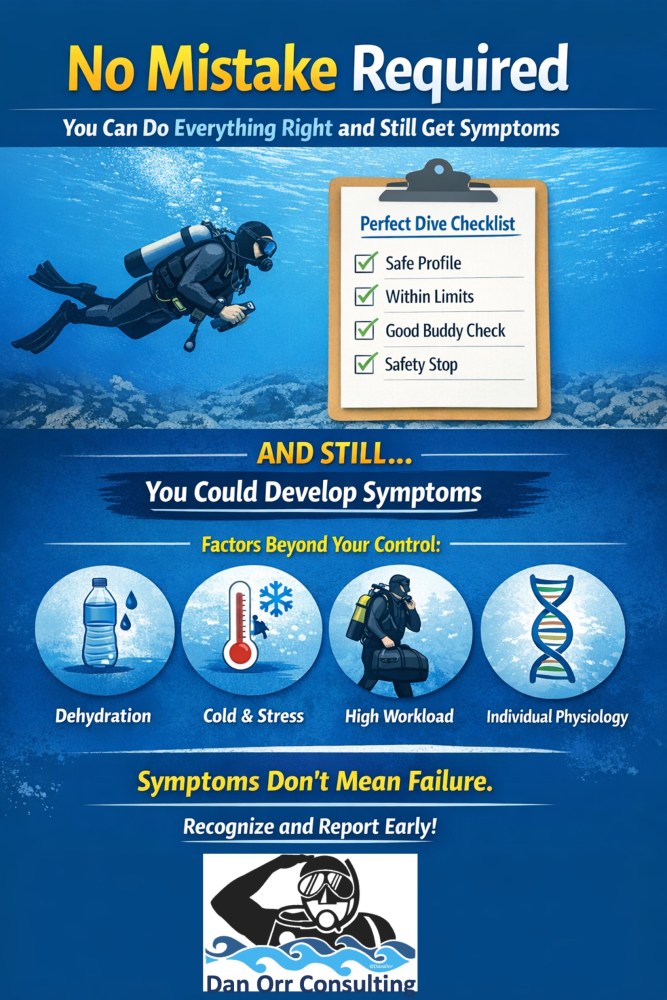
Diving culture can unintentionally discourage symptom reporting. Group dynamics may lead divers to avoid “ruining” a dive itinerary, suppress concerns to align with perceived group norms or equate reporting symptoms with inexperience or the perceived stigma of having “made a mistake.” It should be remembered that divers can do everything right and still develop symptoms. Factors such as individual physiology, hydration status, thermal stress, workload, and environmental conditions all play a role. When divers associate symptoms with “failure,” they are less likely to report them. Dive leaders must actively dismantle this misconception. What matters most is recognizing and reporting anything out of the ordinary early.
In some cases, mild symptoms may temporarily improve without hyperbaric treatment. This transient resolution can reinforce a false sense of security, even as the underlying cause of the symptoms persists. Symptoms may reappear often resulting in a more serious outcome. (Note: Transient resolution of symptoms may occur during emergency oxygen first aid. A diver with symptoms must still seek medical care as the symptoms could reoccur potentially reducing the likelihood of a complete recovery).

Promoting a culture of diving safety requires actively countering these perceptions through leadership, training and the understanding that just because you have symptoms of a diving injury does not mean you did something wrong. The real “wrong” comes from not admitting there is an issue and not reporting it in a timely fashion.
Important concepts in developing a diving safety culture where we feel free to report any symptoms following a scuba dive include emphasizing symptom awareness. Diver training programs should reinforce that any unusual symptom following a dive may be significant, regardless of severity. Instructors and dive leaders should foster an environment in which reporting symptoms is expected and supported, not stigmatized. One way to reinforce and improve decision-making would be to add training scenarios that involve delayed and vague symptoms to training programs, especially diver rescue training. Divers should understand that early consultation, particularly through resources such as Divers Alert Network can improve treatment outcomes, reduce the likelihood of permanent injury and provide reassurance when symptoms are benign.
Delayed reporting of diving-related symptoms remains a preventable risk factor in scuba diving safety. The combination of the potential for vague symptoms, psychological influences, social pressures, and logistical barriers can contribute to this persistent issue.
A critically important principle that exists in diving medicine should be considered highly relevant throughout the diving community: Any unusual symptom after a dive should be considered dive-related until proven otherwise.
By strengthening and improving continuing diver education, understanding and eliminating any stigma associated with diving injuries and promoting early reporting and consultation, the diving community can significantly reduce the likelihood of residual symptoms associated with any diving-related condition such as DCI and IPE. Dive leaders, instructors, divemasters, and trip leaders, set the tone for safety. Their influence extends beyond briefings. They are risk managers, educators, and cultural influencers. By actively promoting early symptom reporting, they create an environment where small problems are addressed before they become serious injuries.
Paid Advertisement
References: Lippmann, J., Caruso, J. (2024). “The Investigation of Diving Accidents and Fatalities” Diving Hyperb Med 2024. Sep 30;54(3):217–224. Mitchell, S. J., et al. (2018). “Pre-hospital Management of Decompression Illness” Undersea Hyperb Med. 2018 May-Jun;45(3):273-286. Orr, D., & Douglas, E. Scuba Diving Safety 2007. Best Publishing Company. Orr, D. “The Normalization of Deviance (aka ‘Short Cut Mentality’).” Scuba Diving Industry Magazine, April 2024. Orr, D. “Dan Orr on Safety, Leadership, and the Future of the Diving Industry.” Inside Scuba. 2025. Orr, D. “The Rule of Three: The Principle for Error Recognition and Critical Rethinking.” Scuba Diving Industry Magazine. January 2026.
(Note: The information presented here is for general informational and educational purposes only and is not intended as medical advice. Readers should consult a qualified healthcare professional regarding fitness to dive or any medical concerns resulting from a dive.)

Click here to read this article on our Flippingbook platform.
More from This Issue:
APRIL 2026 ADVERTISING PARTNERS











RECENT ISSUES




MAGAZINE TOPICS