Why Every Business Needs An Emergency Action Plan

by Jeff McNutt, Chief Operating Officer/Owner of Dive BVI
Click here to read this article on our Flippingbook platform.
NO DIVE CENTER WANTS to think about emergencies – but every responsible dive center plans for them. Scuba diving takes place in an environment where small problems can escalate quickly, and where time, clarity, and coordination matter more than almost anything else.
In the first two articles of this series, we explored how Standard Operating Procedures create consistency and how employee handbooks shape safety culture. This final installment brings those elements together by focusing on Emergency Action Plans (EAPs) – the structured systems that guide calm, effective responses when the unexpected occurs.
At Dive BVI, emergency planning is not about assuming the worst or creating fear. It’s about preparation. When staff know their roles, understand the plan, and have practiced it, emergencies are handled with confidence rather than confusion.
Why Emergency Planning Matters in Dive Operations: Emergencies in diving rarely announce themselves in advance. A diver may surface feeling unwell. Weather can shift rapidly. Equipment can fail at inconvenient moments. In these situations, hesitation and uncertainty can cost valuable time.
An Emergency Action Plan removes guesswork. It clearly defines who takes charge, who provides care, who manages the rest of the group, and who communicates with emergency services. Instead of everyone trying to help at once – or waiting for instructions – each team member knows exactly what is expected of them.
For dive centers, this clarity protects divers, staff, and the business itself. It also demonstrates professionalism to guests, many of whom may never see the plan but will feel the confidence it creates.
Types of Emergencies Dive Centers Must Prepare For: Effective emergency planning starts with acknowledging the range of scenarios that can occur. Dive centers like Dive BVI plan for both diving-related and non-diving emergencies.
These may include decompression illness, barotrauma, panic or stress-related incidents, missing or separated divers, medical emergencies unrelated to diving, equipment failures, and sudden environmental or weather changes.
Planning for these situations does not mean expecting them to happen. It means recognizing that preparation is part of responsible operations in a high-risk activity.
Core Components of an Effective Emergency Action Plan: A strong EAP is clear, practical, and integrated into daily operations. It typically includes several key elements.
Defined Roles and Chain of Command are essential. During an emergency, everyone should know who is in charge and who supports specific tasks. This prevents confusion and conflicting actions.
Communication Protocols outline who contacts emergency services, who communicates with shore staff or management, and how information is relayed accurately and calmly.
Equipment Readiness is another critical component. Oxygen kits, first aid supplies, radios, and signaling devices must be available, maintained, and checked regularly. Dive BVI incorporates equipment checks into routine SOPs so emergency gear is never an afterthought.
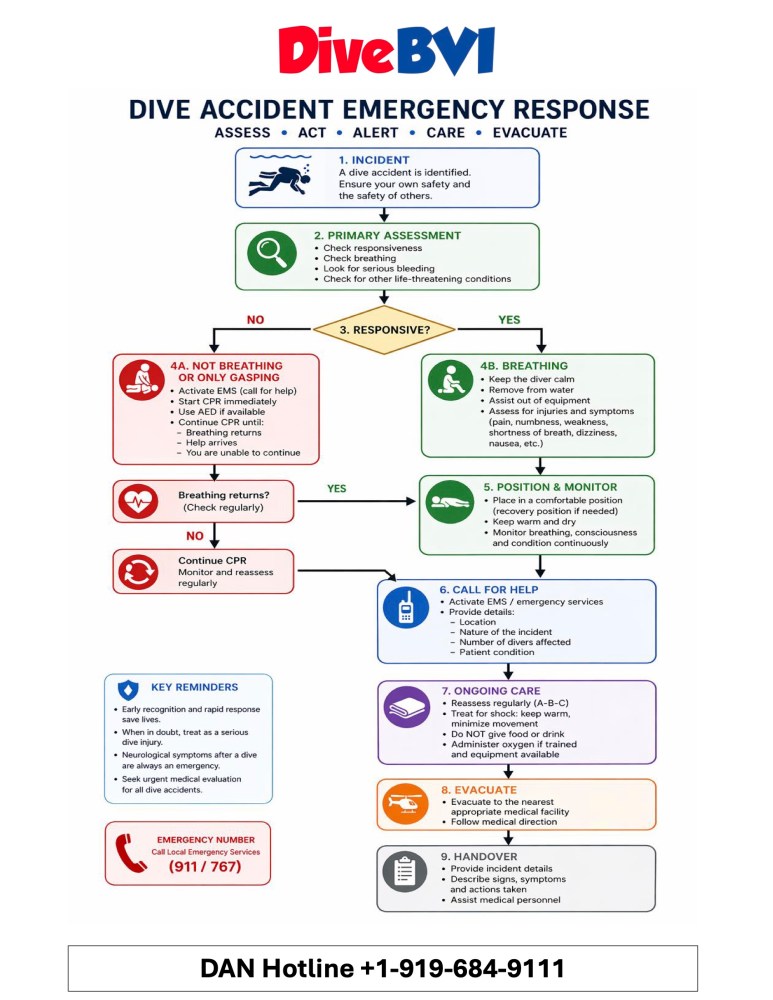
Integrating EAPs with SOPs and Staff Training: Emergency plans are only effective if they are practiced. At Dive BVI, EAPs are closely tied to SOPs and reinforced through regular training and drills. This integration ensures that emergency responses feel familiar rather than improvised.
Staff training focuses not only on technical skills but also on communication, decision-making, and teamwork under pressure. By rehearsing scenarios, staff build muscle memory and confidence. Conducting these drills allows time for questions from staff and opportunities to practice skills that may not have been used in a while. Take the time to get it done right and your team will be ready to respond in a professional manner.
The Practical Advantage of Preparedness: When emergencies occur, prepared teams respond differently. They move with purpose, communicate clearly, and avoid unnecessary panic. This professionalism reassures both guests and fellow team members, even in stressful situations.
Guests may not remember every detail of a dive, but they remember how a dive center handled a challenge. A calm, coordinated response builds trust and reinforces the perception that they are in capable hands. In many cases, the presence of a well-executed Emergency Action Plan turns what could have been a negative experience into a powerful demonstration of professionalism.
Beyond the immediate situation, preparedness also reduces the likelihood of secondary incidents. Clear role assignment prevents crowding around an injured diver, ensures the rest of the group remains supervised, and maintains overall operational control.

Documentation and Accessibility of Emergency Plans: An Emergency Action Plan must be more than a document stored in an office drawer. At Dive BVI, EAPs are written in clear, accessible language and made readily available to all staff. Key procedures are summarized in quick-reference formats on boats and at dive facilities, ensuring that critical information can be accessed even under pressure.
Documentation typically includes emergency contact numbers, evacuation routes, nearest medical facilities, chamber locations, and step-by-step response outlines for common scenarios. These details are regularly reviewed to ensure accuracy, especially in destinations where medical services, phone numbers, or transportation options may change.
Accessibility also means that new staff are introduced to emergency procedures early in their onboarding process. Familiarity with the plan from day one reinforces its importance and prevents gaps in understanding during real-world situations.
Regular Review and Continuous Improvement: Emergency planning is not a one-time task. Dive operations evolve, staff members change, equipment is updated, and lessons are learned through experience. Effective dive centers treat Emergency Action Plans as living documents.
After drills, near-misses, or actual incidents, Dive BVI reviews what worked well and what could be improved. Feedback from instructors, divemasters, captains, and shore staff is encouraged. This collaborative approach strengthens the plan and reinforces shared responsibility for safety.
Regular reviews also ensure compliance with industry standards and best practices. As training agencies update recommendations or new safety insights emerge, EAPs are adjusted accordingly. This commitment to continuous improvement reflects a proactive rather than reactive approach to risk management.
Paid Advertisement
The Human Factor: Managing Stress and Decision-Making: One of the most overlooked aspects of emergency planning is the human element. Even highly trained professionals can experience stress, hesitation, or tunnel vision in unexpected situations. A well-designed EAP accounts for this by simplifying decisions and reducing cognitive load.
Clear checklists, predefined roles, and practiced routines allow staff to act without needing to invent solutions in the moment. This structure supports better decision-making when adrenaline is high and time is limited.
At Dive BVI, training emphasizes situational awareness and calm communication. Staff are encouraged to slow down mentally, confirm actions verbally, and support one another. These soft skills are just as important as technical proficiency in managing real emergencies.
Legal, Ethical, and Business Considerations: From a business perspective, emergency planning is also a form of risk management. Clear procedures demonstrate due diligence and responsible operation, which can be critical in the event of incident reviews or legal scrutiny.
Ethically, dive centers have a duty of care to their guests and staff. Providing a safe environment includes being prepared to respond when things go wrong. An Emergency Action Plan formalizes that commitment and ensures it is consistently applied.

Insurance providers, regulators, and training agencies increasingly expect documented emergency procedures. Dive centers that prioritize EAPs not only protect their operations but also position themselves as leaders within the industry.Emergency Planning as Part of Safety Culture: Perhaps the most important impact of emergency planning is cultural. When staff see that leadership invests time and resources into preparation, it reinforces the message that safety matters. Emergency Action Plans are not about fear or pessimism; they are about respect for the environment, the activity, and the people involved.
At Dive BVI, emergency planning is woven into daily operations rather than treated as a separate or uncomfortable topic. This normalization removes stigma and encourages open conversations about risk, readiness, and improvement.
A strong safety culture does not eliminate emergencies – but it changes how they are handled. It replaces panic with purpose and uncertainty with confidence.
Paid Advertisement
Conclusion – Preparedness as Professionalism: Emergency Action Plans are the bridge between policy and action. They bring together SOPs, training, and culture into a practical framework that guides dive centers through their most challenging moments.
For dive operations like Dive BVI, emergency planning is not about expecting accidents – it is about honoring responsibility. By defining roles, practicing responses, maintaining equipment, and fostering clear communication, dive centers create an environment where both staff and guests feel secure.
In the dynamic and unforgiving marine environment, preparation is not optional. It is a hallmark of professionalism. And when the unexpected occurs, it is preparation – not luck – that makes the difference.
This concludes our three-part series on dive center operations and safety.

Click here to read this article on our Flippingbook platform.
More from This Issue:
APRIL 2026 ADVERTISING PARTNERS