“The competition is not the shop down the road.“

by Candice Landau, Freelance Writer and Underwater Photographer, NC
Click here to read this article on our Flippingbook platform.
FOUNDED IN 1956 and now operated by its second generation, this Oregon dive shop has lived through booms, busts, and a pandemic. Here’s how owner Michael Hollingshead keeps the doors open.
When Eugene Skin Divers Supply (ESDS) opened its doors in 1956, recreational scuba was in its infancy. There were no dive computers, no buoyancy compensators, and no certification standards. Most of the dive shops that would one day become its competitors had not yet been imagined. Seventy years later, nearly all of those shops are gone while ESDS is still here, still independent, still family-run, and by the sometimes brutal standards of the dive industry, still thriving.
The man behind the counter is Michael Hollingshead, the second generation of his family to run it, alongside his wife, Diana. The shop sits in Eugene, Oregon, a place better known as ‘Track Town USA’ for the Olympic Trials and other elite track-and-field events it hosts. Every retailer who’s weathered the highs and lows of running a small business, and who hears ESDS has been in business for 70 years, eventually asks the same question: what’s the secret? It isn’t a lucrative inheritance, and it isn’t access to gin-clear water. If anything, it’s the opposite. The water off the Oregon coast stays below 50 degrees for much of the year, and there’s no benefactor underwriting the shop. In fact, the stuff that keeps it in business may seem to many, entirely unglamorous. The good news? Hollingshead believes his success is replicable and he wants to share it with others.
Raised on a regulator.

The store began as a hobby that got out of hand. Hollingshead’s father Don and a partner, bought an air compressor, picked up a little gear, pulled in some friends, and ran the whole operation out of a garage. By around 1960, his father bought out the partner and moved the business into the back room of an appliance store a couple of blocks from where it sits today. His mother worked the counter during the day, answering the phone and filling tanks. His father, an industrial machinist, a World War II Marine, and ‘a very hard worker,’ according to Hollingshead, kept the business going on nights and weekends until the mid-1960s, when it finally became a full-time operation.
Hollingshead grew up in the midst of it all. “We didn’t have daycare or things like that back then,” he says, “so my mom basically raised me in the store. I grew up playing with scuba gear as toys.” By age 9, he was cleaning up and patching neoprene boots and gloves for a quarter an hour. When the shop’s manager moved on in the late 1970s, Don – ready to step back and travel – gave his 19-year-old son a choice. He asked if this was the life he wanted, or if he’d rather be doing something else. Hollingshead chose the shop. Shortly thereafter, he took another step that would be instrumental in helping the business save money. “I became an instructor in 1979 because I felt that it was imperative we try to control our costs. When you don’t pay yourself for teaching, it’s one way of keeping your revenue stream up.”
The shop started under NAUI and became a PADI store around 1972, early enough for the shop to receive a PADI store number Hollingshead still grins about today: 911. “Don’t worry,” he tells customers, “it’s not for that reason.”
Evolve slowly, and on your own terms.
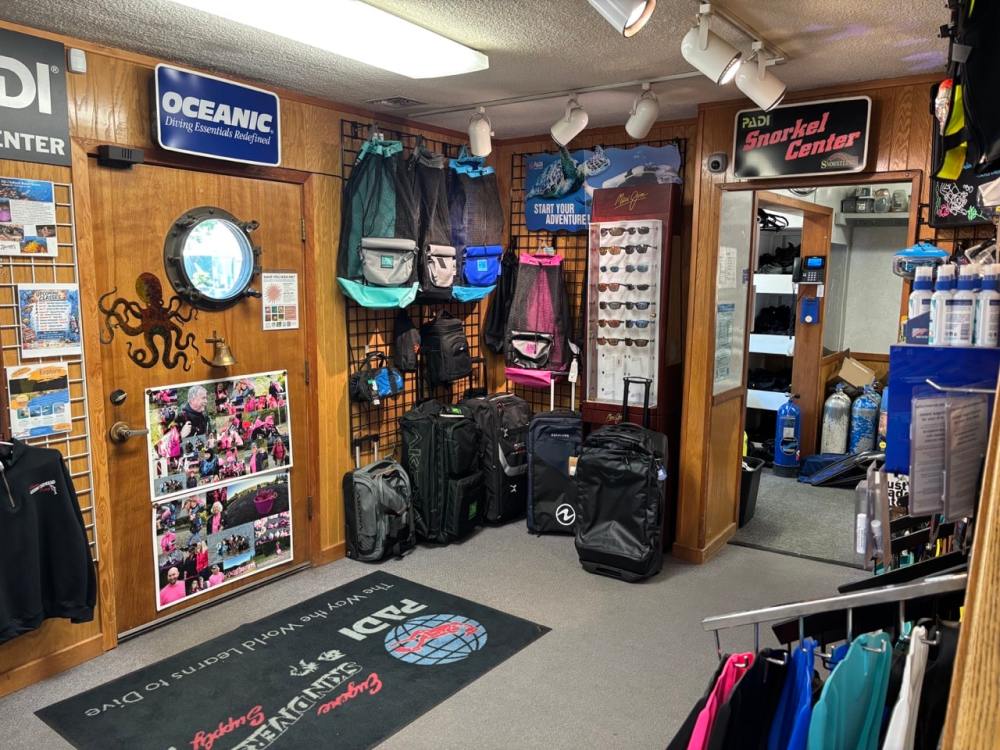
Walk the floor of ESDS and you get glimpses of the past: a black-and-white photograph of Don from the early days, a shiny brass commercial diving helmet, and a glass cabinet filled with curiosities from beneath the surface, including old regulators and a porthole still covered in barnacles. All of it sits alongside new dive equipment.
In the early years there was almost nothing to sell beyond a tank, a backpack, and a wetsuit; the real business was teaching and repair, with Oregon’s coastal spearfishing competitions helping drive sales. The 1970s brought buoyancy compensators and a full-time service department; the late 1990s brought dive travel, travel-friendly gear, and higher-margin training, like enriched air nitrox.
Hollingshead’s instinct throughout has been to change carefully rather than chase the latest trend. He keeps an active online presence – website, email newsletter, Facebook – but won’t sell gear online; the in-person approach, he argues, lets the shop educate customers rather than just sell to them. The one piece of passive marketing he swears by is the T-shirt divers earn for finishing their Open Water course, declaring them proudly certified in the Pacific Northwest. Students love to wear it, and the shop’s logo sits front and center.
Run lean.
The one time the store came closest to not making it was during the pandemic. “It was the hardest time of my life as far as the business goes,” Hollingshead says. Eugene shut down. The pools closed for nearly a year, and even some areas of the local lakes where they trained were closed. Though a lot of hard decisions had to be made, Hollingshead kept every employee on. He gave employees time off without reducing their pay and took advantage of PPP loans and any other programs available to him. But the bigger change was strategic. Years of saying “yes” to dive gear manufacturers had left the shop carrying too many brands, too much inventory, and thus too much pressure from manufacturers to buy into programs to protect margins. Hollingshead finally cut back to the lines he genuinely believed in and made real money on. That helped a lot.
But the part he still gets emotional about is the support the shop got from customers. It was the regulars – longtime customers who came in during the worst of it and quietly bought a regulator, dive computer, or gift certificate, often purchasing something they did not need, and told him plainly they wanted to make sure the shop survived. Sure enough, it survived at a time when many other dive shops did not. “It’s still emotional when I think of it,” Hollingshead says, tearing up.
Paid Advertisement
The competition is not the shop down the road.
Ask Hollingshead who he’s up against and he won’t name another dive store. “Quit looking at other dive shops as enemies.” The real competition, the way he sees it, is everything else pulling at a customer’s time and money. It’s the jet-ski dealer, the paddleboard shop, the rafting outfitter, the mountain bike store. Outdoor recreation has exploded, and all of it drains from the same pool. People simply don’t have time to fully commit to all these activities.
So he doesn’t poach customers and he welcomes anyone who walks in from another shop. He swaps notes with owners in Seattle and Portland, because the way he sees it, the industry is small and the real threat to the business is online stores. Brick-and-mortar stores survive only if shops help customers understand their value. “Us dive shops have to work together to get people into the mindset of supporting their local business. We have to earn their trust. We have to make them want to do business with us. We have to make them want to see us survive.”
People you don’t have to replace.
Another part of the secret sauce is the staff. ESDS barely turns anyone over. John, the Assistant Manager, gave the shop 44 years before retiring. Ed, the service technician, has been there close to four decades; Ron, the store manager, more than three. Customers vanish for twenty years, walk back in, and ask whether Ed is still doing repairs and whether Ron is still around. He is. Better yet, he’ll likely remember your name.


Hollingshead has never paid staff on commission. “Commission-based sales are pressured sales, and that’s not what built our success.” He pays fair salaries, brings staff into decisions, and runs the shop – as hokey as he admits it sounds – like a family. He also leads from the floor. “If I need to put wrist seals on a dry suit, I do it. If I need to work on a regulator, I do it.” But, he doesn’t stop there. Every day he cleans the toilets, wipes the counters, and vacuums. “That’s something my dad did every single morning, whether he was going to be there that day or not. He’d come in, do that, make the coffee, then leave.” Hollingshead believes in leading by example. “I think a lot of owners lose something when they stop being personally involved in running the business.”
That ethic extends into the teaching, too. Roughly 95 percent of ESDS courses are team-taught, which helps spread the load and keeps good instructors from burning out. Open Water classes are deliberately stretched over four weekly evenings plus an open-water weekend so students have time to absorb what they’re learning. And, the strongest instructors mentor the next ones.
What customers actually buy.
Pressed for the one piece of advice he’d give a younger retailer, Hollingshead doesn’t hesitate: customer service. The real thing, not the slogan. Plenty of shops say they offer great service, he notes, but fail to deliver it. At ESDS it means fixing a customer’s mask or fin in the back room, often for free, and handing it back without a sales pitch. It means staying late. It means learning every customer’s name and using it. “You can’t force sales, but if you treat them right, you’ll get a sale. Maybe it’s next week, maybe it’s next month, but you’ll get it, and you’ll get good vibes.”
As for the future, Hollingshead’s plan is the one that got him here. Stay lean, stay current on gear and technology, and keep the service better than anyone else’s. He has no exit plan, and no real interest in one. He still dives. He still loves it.
Hollingshead closes the interview by relaying something he often hears from customers who walk in having been away for a time. “Oh,” they tell him, breathing in the neoprene and the glue and the rubber, “I miss the smell of the dive shop.” To Hollingshead it’s the smell of another day. To them, he’s come to understand, it smells like coming home.
Paid Advertisement

Click here to read this article on our Flippingbook platform.
More from This Issue:
THIS MONTH’S ADVERTISING PARTNERS