

A guide for attendees and exhibitors: the ins and outs of DEMA show etiquette.

BEFORE SCUBA, I WAS A visual merchandiser and conceptual designer, already developing CoCo Cheznaynay®, Secret Agent of Truth & Style™, built around owning who you are and facing your fear. Then I started scuba lessons and, rather inconveniently, I had to test her philosophy myself.
Learning to dive gave me a whole new environment to observe: the people around me, what was working and what wasn’t. That habit still guides how I look at a trade show floor, and life. So yes, there may be a little Secret Agent in here, too. Observe first. Read the room. Gather your intel. Then proceed accordingly.
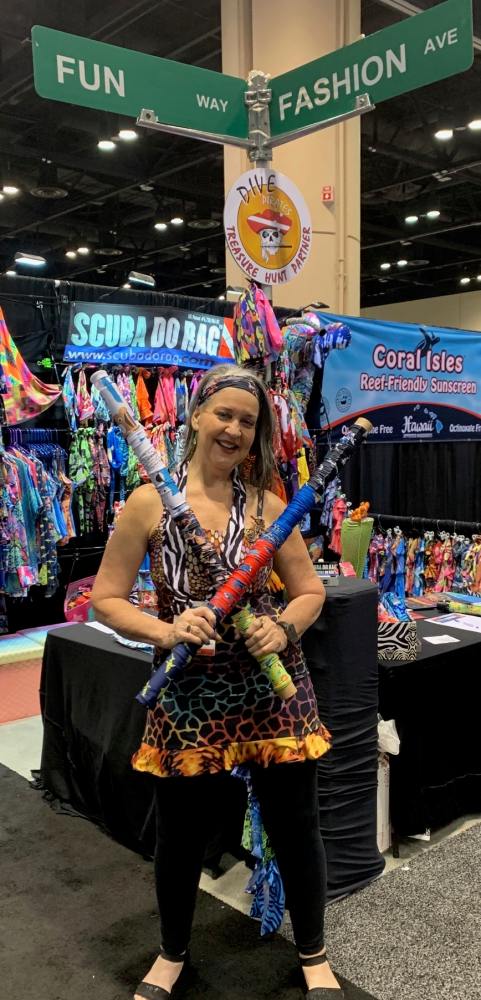
Recently, a question in an industry social media group caught my attention. A new international dive retailer had been offered an exhibitor badge and wondered whether accepting it would allow her to accomplish what she was coming to do. Her question made me realize how much of trade show culture is simply assumed.
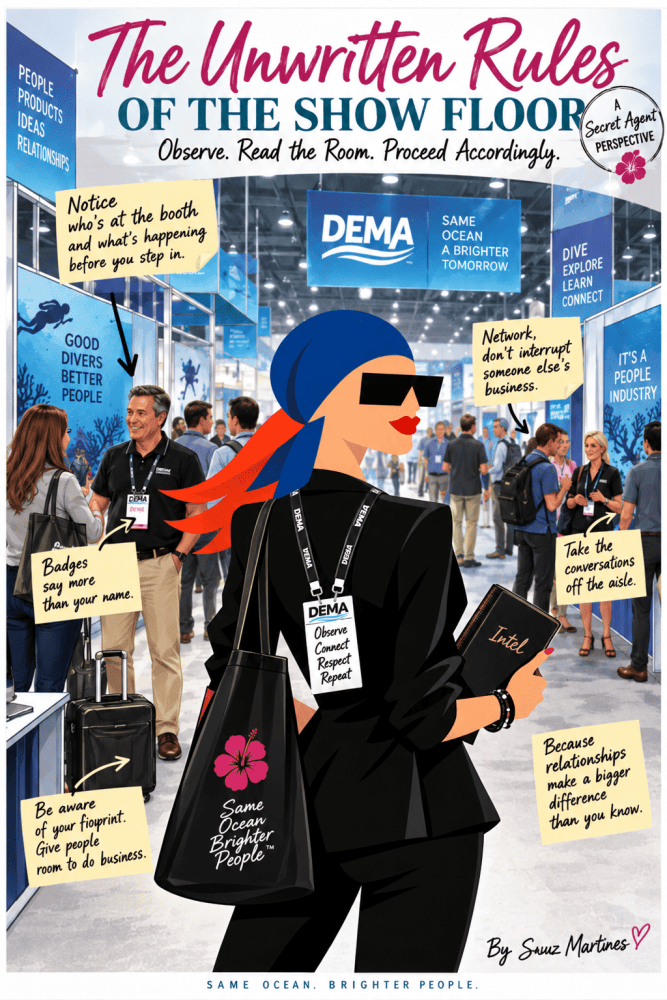
Your Badge Says More Than Your Name: Your badge tells people why you are there and, particularly when you are wearing an exhibitor badge, who you represent. If you aren’t sure which registration category fits your role, ask. DEMA recommends choosing the category that best reflects what you are coming to do.
And learn to read the badges. Every good Secret Agent knows to check the credentials. They offer clues about someone’s role at the show. When our booth gets busy, I remind my staff to recognize the Buyer badge and notice when a buyer may be waiting. If you’re visiting with an exhibitor or catching up with an old friend, look around occasionally. If someone is waiting to do business, that may be the moment to pause. It isn’t about one badge holder being more important than another. It’s about reading the room.
Read the Booth Before You Enter It: The dive industry is wonderfully social. For many of us, DEMA is part business meeting, part reunion. But if you’re having a 20-minute conversation with an old friend while potential customers approach and leave, perhaps relocate the reunion.
Paid Advertisement
In Secret Agent language: observe first. Read the room. Know when to step in and when to step aside.
A booth may look effortless, but someone spent hours or days planning it. Merchandise on display is not necessarily a free sample, and that unorganized pile may actually be a buyer’s order in progress. Ask before picking something up, and find another home for the coffee cup, lunch plate or half-eaten convention-center cookie. Your visual merchandiser will thank you.
Networking Is Not the Same as Prospecting: One of the best things about DEMA is the opportunity to meet people. Make connections. Introduce yourself. Ask questions. But there is a difference between networking and using someone else’s booth, badge, introduction or customer relationship as a shortcut to pitch your own business.
There’s also a trade show term worth knowing – Suitcasing: In general, it refers to attending a trade show without exhibiting and actively soliciting business on the show floor. Build your own relationships, but pay attention to where you’re standing and whose conversation you’re entering.
An exhibitor has invested in booth space, travel, displays and staff. There are only so many show hours to meet customers and buyers. Networking should add to the show experience, not interrupt someone else’s opportunity to do business. Plus it’s strictly against the show rules!
If You’re Wearing Someone Else’s Badge: If someone has invited you to help in their booth, don’t assume you automatically understand trade show culture. We don’t know what we don’t know. Ask what’s expected. Know how to respond when a buyer enters, which questions you can answer and when to ask for help.
Paid Advertisement
While you’re wearing someone else’s exhibitor badge, you’re representing that company even when you leave the booth. If someone is working with a buyer, give them the same room to do business you’d want someone to give you. Access also comes with confidentiality. Customer information, pricing, unreleased products and behind-the-scenes business information aren’t yours to repeat, photograph, share or use for your own advantage.
It has taken me roughly 25 years to build the trust that brings buyers and customers back to my booth. When I put my company’s badge around someone’s neck, I’m extending some of that trust to them. Meet people. Make connections. Build your own relationships. But don’t use someone else’s introduction, booth, badge or customer relationship as a shortcut to pitch your own business.
Remember Who You Represent: DEMA’s Nicole Russell put it simply: “Remember you represent your company. Be friendly, welcoming and professional whether you’re exhibiting, buying or simply walking the floor.”
That doesn’t end when the exhibit hall closes. DEMA has receptions, dinners, parties and plenty of socializing. But we’re still surrounded by customers, colleagues and others in our industry. Enjoy yourself, but know your limits. I learned this lesson the uncomfortable way. One year during setup, a fellow exhibitor recognized one of my booth assistants from the previous show. What he remembered wasn’t ScubaDoRag or something wonderful she had done in our booth. He remembered how intoxicated she had been the year before. And I did not know.
That stopped me in my tracks. She had been on her own time, but a year later, that was the memory connected to someone who had represented my company. Once an impression has been made, you don’t get to go back.
Paid Advertisement
Watch Your Finprint: Divers should understand this better than most. Put us underwater and suddenly we’re learning a whole new awareness of where our body and fins are in space. We learn our finprint: how much room we actually occupy and how our movement affects the people around us.
A busy show floor isn’t so different. Your footprint may include a group conversation spreading across an aisle, the rolling bag behind you or standing in front of another exhibitor’s booth while you finish a story. Again, none of this requires a rulebook. It requires noticing. Where am I standing? Is someone waiting? Am I making it easier or harder for the people around me to do what they came here to do?
Professional Doesn’t Have to Mean Stuffy: DEMA is built on experiences, travel, adventure, stories and friendships. We should laugh, reconnect, welcome a newcomer and send someone toward a booth they shouldn’t miss. Professional courtesy isn’t about making the show more formal. It’s about making room for all of that while remembering why everyone is there.
After all these years exhibiting, I’m still learning, too. Others experience the show from different sides of the aisle or notice things the rest of us stopped seeing. These are my observations from one corner of the show floor, not the final word.
The best show culture isn’t created by a list of rules. It’s created by an industry willing to share what it’s learned.
Paid Advertisement
“We track potential dive trips to see if they fit in well with our clientele and their schedules,” Thomas said. Thomas said it was important to know and understand your travel clients, as some may be able to afford extended trips to far-off destinations, while others may only have vacation time and travel allowance for either a long weekend or a one-week adventure to a closer location that fits their budget.
In Summary: After the DEMA Show is over, there are many follow-up action items that need to take place in order to take advantage of attending the show. Instead of putting these items on the “back burner” when you get back, it is important to follow the old adage of “strike while the iron is hot” to ensure your mission to the show is a success for your dive center. Following up quickly with contacts, manufacturers, travel companies, and your entire staff after the show will keep the momentum going for a positive boost to your business.

Click here to read this article on our Flippingbook platform.
More from This Issue:
THIS MONTH’S ADVERTISING PARTNERS












RECENT ISSUES




MAGAZINE TOPICS