How to avoid the ‘Checklist Mentality‘

IT WAS THE SUMMER OF 1958 in Miami, Florida, when I took my very first breath underwater. I was eleven years old, and a friend and I had “borrowed” a single tank, a regulator, and two masks from his older brother. We had absolutely no training, no concept of physics, and certainly no understanding of the physiological consequences of what we were doing. We survived that day purely on luck.
Later in my life, after a tour of duty in the U.S. Navy and decades spent working in diving safety and education, I came to realize a fundamental truth: luck is not a safety plan.
Over the last fifty years, our sport has undergone a remarkable transformation. Equipment has become incredibly reliable, and the path to certification has become faster, more streamlined, and more accessible than ever. But as training has evolved to fit into busy modern lifestyles, we have arrived at a critical crossroads in the diving industry.
Today, we see a distinct division in how new divers are minted. On one side, we have the “minimum standards instructor,” someone who treats the training manual as a checklist, moving students through the curriculum as efficiently as possible. On the other side, we have the “diving educator,” an individual who understands that certification is not the end goal, but rather the starting line of a lifelong educational process designed to produce safe, self-reliant, and analytical divers.
Understanding this difference is not just an academic exercise. For those of us dedicated to reducing diving accidents, it is a matter of life and death. From the perspective of the diving industry, it’s a matter of certifying divers versus creating those who will most certainly enjoy scuba diving for a lifetime.
The Checklist Mentality: The Risk of the Minimum

To understand the minimum standards instructor, we have to look at the business model of modern scuba training. In a highly competitive market, there is constant pressure to reduce costs, shorten classroom times, and get students certified in as few hours as possible.
An instructor who adheres strictly to “minimum standards” is not necessarily violating any rules. They teach exactly what the training agency requires. They check the boxes:
- Did the student perform a mask clear? Yes.
- Did they demonstrate regulator recovery? Yes.
- Did they complete the four required open water dives? Yes.
But there is a vast and potentially dangerous difference between performing a skill once under ideal conditions and mastering that skill so it becomes an automatic, stress-free reaction in an emergency.
When we teach to the bare minimum, we create “card collector” divers who possess a plastic credential but lack the comfort, situational awareness, and critical thinking skills required to manage real-world diving conditions. These divers are often highly dependent on their divemaster or guide. If conditions change, or if a minor equipment glitch occurs, they lack the mental bandwidth to cope. The result is often “task fixation,” panic, and, tragically, an escalating chain of errors that can lead to a serious accident.
The Diving Educator: Facilitating the Educational Process
A true diving educator looks at training through a completely different lens. To them, standards are not a ceiling to reach; they are a basement, a foundational starting point from which to build.
An educator does not just teach how to clear a mask; they teach why comfort with water in the nose is the single most critical factor in preventing the classic “panic-and-escape” ascent. They do not just show a student how to read a dive computer; they help them understand the real-world physiological factors – hydration, thermal stress, and age – that a computer’s mathematical algorithm cannot calculate.
This approach transitions training from rote memorization to a true educational process. It is characterized by three core pillars:
Paid Advertisement
1. Developing Comfort and Mastery Through Repetition
In psychology, there is a concept known as “overlearning.” It means continuing to practice a skill long after initial mastery has been achieved. A diving educator understands that under the stress of an underwater emergency, our cognitive capacity shrinks dramatically. If a skill is not hardwired into muscle memory, a diver will struggle to execute it.
An educator structures pool sessions to allow for repeated, stress-free practice. They introduce minor distractions, encourage play, and give students the time they need to truly feel weightless and comfortable. They do not rush. If a student needs extra time in the pool to master buoyancy or regulator recovery, they get it because a true educator refuses to take a student into open water until they are demonstrably ready.
2. Teaching Analytical Thinking and Risk Management
When my wife, Betty, and I wrote 101 Tips for Recreational Scuba Divers, we emphasized the importance of individual responsibility and situational awareness. A diving educator instills these values on day one.
One of the most important concepts we teach is what I call “The Rule of Three.” In analyzing decades of dive accidents, we rarely find a single, catastrophic event that caused a fatality. Instead, accidents are almost always the result of a compounding chain of minor, seemingly insignificant errors.

My Rule of Three is simple: If you experience three errors, anomalies, or “hiccups” during your pre-dive preparation or the dive itself, you must pause, reassess, and seriously consider aborting the dive.
- Error 1: You realize you forgot your mask anti-fog in the car.
- Error 2: While gearing up, you find a small, slow leak coming from your pressure gauge.
- Error 3: The sea conditions have picked up, and there is a mild, unexpected current at the surface.
A diver trained by a “minimum standards” instructor might shrug these off individually, pushing forward because “the instructor is on the boat” or “I paid for this charter.” A diver trained by an educator recognizes these three events as an escalating chain of risk. They have been given the “permission to call” the dive at any time, for any reason, without fear of embarrassment. This is the “no fault” philosophy about anyone’s ability to “call” a dive at any time for any reason. This mental shift from passive follower to active risk manager is what keeps divers alive and looking forward to their next dive.
Paid Advertisement
3. Fostering a Culture of “Experience-Based” Progression
When I established the scuba diving program at Wright State University in 1973, we didn’t just teach people how to breathe underwater and send them on their way. We built a progressive curriculum. We offered entry-level courses, but we immediately followed them with “Experienced Open Water” classes that exposed students to 25 dives in varying conditions: rivers, quarries, night, and low-visibility environments.
Diving educators do not encourage their students to collect advanced plastic cards immediately after their open water course. Instead, they encourage them to gain logged, varied experience under mentored supervision. They teach their students that the best “advanced” training is simply diving in different environments with more experienced buddies, slowly expanding their personal comfort zones.
Comparing the Two Approaches
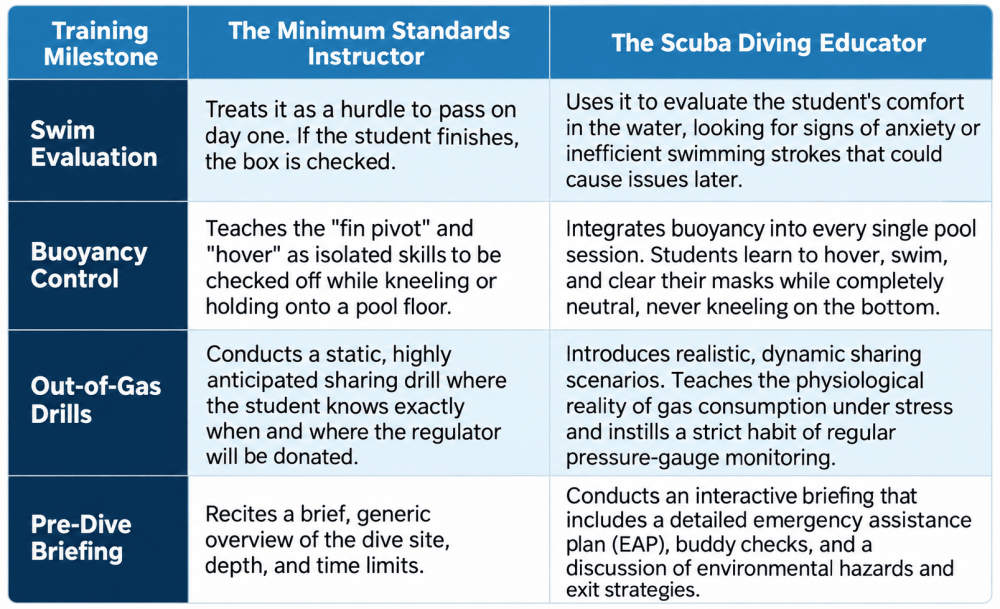
To see how these two philosophies play out in the real world, let’s look at how an instructor versus an educator handles common training milestones:
The Legacy of the Educator
As I look back on my decades in this industry, from my early days teaching university students to my years leading Divers Alert Network, I am constantly reminded of the students who stayed in the sport. They didn’t stay because the class was fast or cheap. They stayed because they were inspired. They stayed because their instructor and staff gave them the confidence, the skill, and the deep respect for the underwater world that transformed them from tourists into true diving advocates.
If you are an instructor reading this, I challenge you to look at your next class not as a set of standards to meet, but as a group of human beings who are trusting you with their lives. Don’t just teach them to survive the weekend. Teach them the physics, the physiology, the risk management, and the emotional discipline required to dive safely for the next thirty, forty, or fifty years.
Remember, the certification card should only be a beginning. The true measure of instructional effectiveness is not whether students successfully complete required skills during training. It is whether they continue to dive safely and confidently years later.
Our responsibility as instructors extends beyond compliance with standards. We are educators. We introduce people to an environment that is beautiful, challenging, and potentially unforgiving.
Paid Advertisement
We have the opportunity, and the obligation, to develop divers who can think, adapt, recognize hazards, and make sound decisions.
Ultimately, successful diver education is not measured by the number of certifications issued. It is measured by the number of divers who continue to safely enjoy the underwater world throughout their lives and share their positive experiences with others.
Our oceans are beautiful, magical places but they can be unforgiving of complacency. Let us leave the checklist behind, embrace the true educational process, and ensure that every diver we train returns home safely from every single dive looking forward to the next diving experience.
Additional Reading: Orr, D. and Orr, B. 101 Tips for Recreational Scuba Divers. 2023. Best Publishing Company. Orr, D. and Douglas, E. Scuba Diving Safety. 2017. Best Publishing Company. Orr, D. Diving Safety articles in Scuba Diving Industry Magazine (www.scubadivingindustry.com).
Paid Advertisement
She also described diving as the closest she expects to come to being an astronaut. Divers must remain aware of their safety and equipment while entering a place few people experience directly. “You get to see new things, and you make some of the best friends you will have for life,” she said. “It is a wonderful community, and I feel blessed to be part of it.”
That combination of professional association experience and a personal love of diving gives Fabsik-Swarts an opportunity to see DEMA from more than one perspective. She understands associations, but she also understands why people become divers and why so many choose to build their careers around the water.
Her first task is to listen. What comes next will depend in part on what DEMA’s members tell her and how willing they are to participate in shaping the association’s future.

Click here to read this article on our Flippingbook platform.
More from This Issue:
THIS MONTH’S ADVERTISING PARTNERS