

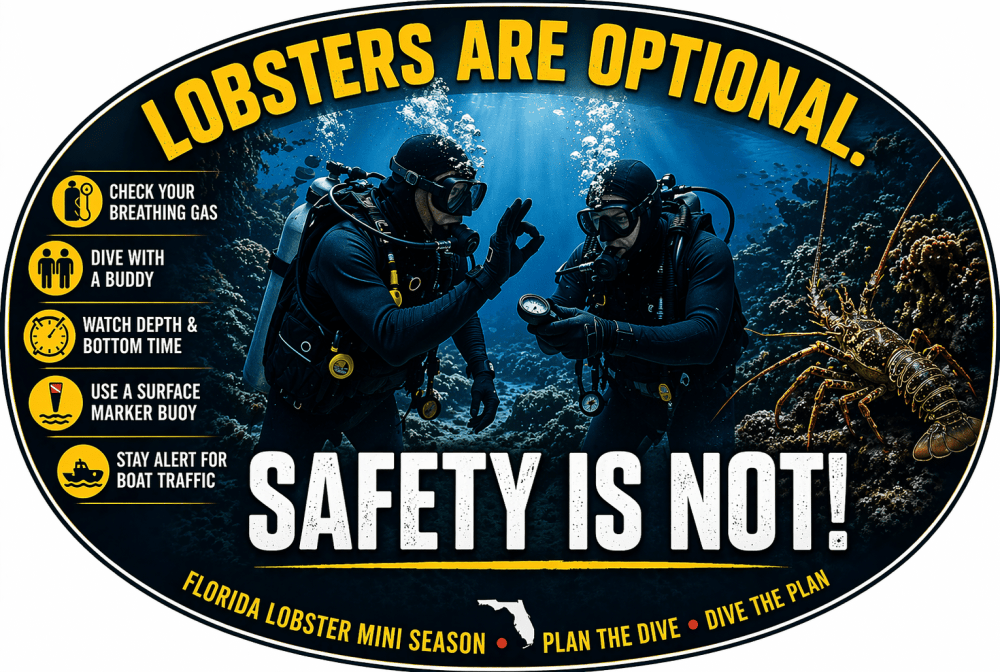
Dive Centers: Click Here for a Downloadable Mini-Season Safety Poster

EVERY YEAR, the Florida Spiny Lobster Mini-Season brings a surge of excitement to the diving community. Boats fill before sunrise, cylinders are topped off, tickle sticks are packed, and divers, many of them infrequent or inexperienced, head out with one goal in mind: bugs in the bag. But alongside that excitement comes a predictable and troubling pattern. Emergency calls increase. Near-misses become too common. And, tragically, injuries and fatalities occur that could have been prevented.
Since its creation, Florida’s two-day lobster Mini-Season (July 29 & 30) has repeatedly produced spikes in scuba, snorkeling, and boating-related accidents, with multiple serious injuries and recurring fatalities reported in many years. However, the true total number of diving injuries is unknown because no centralized database tracks every incident.
Divers Alert Network (DAN) has noted that, over several years, Mini-Season diving has averaged about two diving-related fatalities per lobster Mini-Season. Injuries from boat strikes, propellers, out-of-gas situations, and barotrauma are more numerous than fatalities, but again, there is no centralized public database reporting all injuries each year. Mini-Season is statistically one of the more dangerous recreational diving windows in Florida due to increased participation and boating activity.
For dive professionals, this is not just a seasonal uptick in business, it’s a responsibility moment. The reality is simple: Lobsters are optional. Safety is not.
To reduce incidents, injuries, and fatalities during Mini-Season, dive professionals must lead from the front, not just with skills, but with expectations, culture, and clarity. The biggest risk factor during Mini-Season is not currents, depth, bottom time, or marine life, it’s human behavior. More specifically: urgency, competition, and distraction. Divers become task-loaded, sometimes task-overloaded. The hunt becomes the focus. Basic safety habits are sometimes left at the dock or shore.
Dive professionals can actively counter this. Before any charter, class, or guided dive, set the tone by emphasizing that this is not a race or competition. No lobster is worth compromising safety. Make this part of every briefing, not as a throwaway line but as a clear expectation. Say it plainly: “If you come back without a lobster but followed your plan and stayed safe, that’s a successful dive.” That reframing matters.
The annual Mini-Season attracts divers who may not have been in the water since last year’s Mini-Season or longer. Equipment is dusty. Skills may be rusty, whether you are willing to admit it or not. Overconfidence may rule the day. Dive professionals should take a firmer stance by encouraging, or requiring, refresher dives for those who have not been in the water in a long time. Promote pre-dive safety checks and in-water buoyancy checks before hunting begins, and verify breathing gas and dive planning, not just cylinder pressure. Far too often, professionals assume divers will self-regulate. During Mini-Season, that assumption too often fails.
Consider implementing shallow familiarization or orientation dives for unfamiliar clients, equipment inspections and familiarizations between buddies at the dock, and buddy checks that are actually observed, not implied. A few minutes checking everything before entering the water can be time well spent if it prevents a catastrophic safety issue once in or under the water.

Running low on breathing gas remains one of the most common contributors to diving incidents, and Mini-Season amplifies the risk. In 2008, DAN published a research report reviewing 947 diving fatality records. The number one “Triggering Event” at 41% that turned a recreational dive into a fatal outcome was “running out of breathing gas underwater.” Why does this happen? Because divers push their limits trying to get that one lobster. They stay “just a little longer” under ledges. They chase “just one more lobster.” They lose track of time while task-loaded.
“Don’t push your limit just to bag your limit!” One other thing to keep in mind regarding the above DAN fatality data: DAN evaluated a more recent group of fatality data in 2015 to see if anything had changed. The results showed that the number one triggering event had changed from “running out of breathing gas underwater” to “underlying health issues.” Therefore, it is essential for all divers, especially those over the age of 50, to have had a recent physical from a healthcare professional familiar with diving medicine.
It is incumbent upon dive professionals to re-emphasize the rule of thirds, or other appropriate breathing gas planning methods, to require divers to call the dive based on breathing gas, not catch count, and encourage the use of audible or visual breathing gas alerts when possible. More importantly, normalize conservative diving behavior. When a diver surfaces early with plenty of breathing gas, that should be praised, not questioned or ridiculed.
Lobster hunting adds layers of complexity, such as managing tools, navigating tight spaces, maintaining buoyancy near reefs and ledges, and monitoring depth, time, and breathing gas simultaneously. That’s a lot even for experienced divers.
Dive professionals should emphasize the value of recent diving experience before engaging in lobster hunting. They should also encourage divers to simplify their approach, limit tools to what they can manage comfortably, and stress that buoyancy and position control always come first. A diver who cannot maintain neutral buoyancy may be a hazard to themselves and others. This is not about skill-shaming. It is about risk management and safety.
Mini-Season often turns buddy teams into loosely associated individuals. One diver hunts. The other wanders. Separation becomes common and dangerous. Dive professionals must redefine what buddy diving looks like: stay close enough to act quickly in an emergency, maintain a shared dive plan, and actively monitor each other’s position and condition. Safe divers often encourage role assignment, one hunts while one observes and monitors, then roles are switched regularly. This keeps both divers engaged and may significantly reduce risk.
Another common issue during Mini-Season is divers exceeding their planned depth or bottom time while pursuing lobsters. It happens gradually, a deeper ledge, a longer chase, or a few extra minutes that turn into many. Dive professionals should encourage shallower dive profiles when possible, reinforce the use and understanding of dive computers, and remind divers that decompression obligations and rapid ascents are real risks. Make it absolutely clear: “No lobster is worth decompression sickness or an uncontrolled ascent.”
Paid Advertisement
Many incidents do not happen at depth; they happen during ascent or at the surface. Mini-Season involves heavier than usual boat traffic, distracted boat operators and divers, and poor ascent discipline. Dive professionals should stress controlled ascent rates, mandatory safety stops when appropriate, and the use of dive flags and surface marker buoys. And perhaps most critically, look and listen before surfacing. Boat strikes remain a serious and preventable hazard.
Dive professionals working on or with boats must be especially vigilant during Mini-Season chaos. Key practices include clearly understood diver recall procedures, strict adherence to diver-down flag laws, active boat traffic monitoring, and keeping ladders and entry points clear and safe.

Diver safety during Mini-Season includes reviewing proper entries and exits, emphasizing awareness around boat propellers, and encouraging immediate signaling upon surfacing. In the heat of the hunt, surface safety is often overlooked, but it is where many accidents occur.
Being physically prepared is also critically important when divers may be distracted by the prospect of a lobster meal. Heat, dehydration, fatigue, and overexertion all play a role in diving incidents. Mini-season often means early mornings, long days in the heat and sun, multiple dives, and, unfortunately, alcohol consumption between dives. For most divers, the best approach is simple: arrive well hydrated, eat light but nutrient-dense meals, and ensure adequate electrolytes through food or modest supplementation. I personally like Pedialyte® as it offers effective hydration by replacing lost electrolytes and helping prevent dehydration issues. Pay attention to urine color, aiming for pale yellow, energy levels, and cramping patterns across dive days. Thoughtful hydration, nutrition, and electrolyte management support clearer thinking, better thermoregulation, reduced fatigue, and safer, more enjoyable dives. Also, watch for signs of stress or fatigue in divers. Sometimes the best decision is to sit a dive out. That is not weakness, it is sound judgment.
Dive professionals set the tone and are seen as role models whether they intend to or not. If you skip buddy checks, push limits, or treat safety briefings casually, other divers will follow your lead. But if you demonstrate disciplined behavior, speak up when something is not right, and prioritize safety over convenience or timeliness, that behavior spreads just as quickly. Your actions carry more weight than your words.
Finally, do not assume divers know what you know. Clearly communicate expectations, proper procedures, and risks. Do it directly and repeatedly. Avoid local jargon. Be specific. Invite questions. A well-informed diver is a safer diver. If you are a dive professional on a commercial dive boat, remember those on your boat may be from different parts of the world where different terms and procedures may be the norm. Be sure the pre-dive briefing information is understood by all divers before diving begins. One idea is to treat the pre-dive briefing like the exit row instructions on a commercial flight. Flight attendants ask for a verbal response confirming that passengers understand the rules and procedures. You can do the same with your dive briefing. Getting a verbal response that guest divers understand the briefing before the dive begins is not a bad idea.
The Spiny Florida Lobster Mini-Season will always carry risk. That’s the nature of any high-energy, high-participation event. But the number of injuries and fatalities seen each year is not inevitable. It can be heavily influenced by proper preparation, safe behavior, and effective leadership. Dive professionals are uniquely positioned to shape all three.
By setting expectations, reinforcing fundamentals, and modeling disciplined diving, you can help ensure that more divers return home safely whether they bring lobsters back with them or not. Because at the end of the day, the message is simple and worth repeating: Lobsters are optional. Safety is not.
Dive Centers: Click Here for a Downloadable Mini-Season Safety Poster
Note: The information presented here is for general informational and educational purposes only and is not intended as medical advice. Readers should consult a qualified healthcare professional regarding fitness to dive or any medical concerns resulting from a dive.
Paid Advertisement

Click here to read this article on our Flippingbook platform.
More from This Issue:
May 2026 ADVERTISING PARTNERS














RECENT ISSUES



MAGAZINE TOPICS