

It may be the world’s worst spectator sport, but it’s been growing in popularity for 70 years.

by Gil Zeimer, ScubaStoryteller.com and Zeimer.com, San Rafael, CA. His first book, “Scuba Storyteller: Mostly Humorous Diving Tales by an Addicted AquaNut” is now available on BestPub.com. He will also be a featured speaker with two presentations at Scuba Show in Long Beach
Click here to read this article on our Flippingbook platform.
HAVE YOU EVER HEARD OF underwater hockey? It’s not a bunch of brawny, gap-toothed athletes skating on slushy ice. It’s two teams of six swimmers pushing a three-pound, plastic-coated puck with 11-inch-long sticks across a 6-to-12-foot-deep, 25-by-15-yard pool into a goal at either end, overseen by three swimming refs and another one on the deck.
The game has two 15-minute halves with a three-minute halftime; each team is allowed one 60-second timeout per half. The clock is temporarily halted for goals, rule violations, or injuries. The strategy is similar to basketball, with position players covering zones around the puck, and scoring depending entirely on teamwork. The positions are forwards, strikes, wings, backs, halfbacks, and fullbacks.
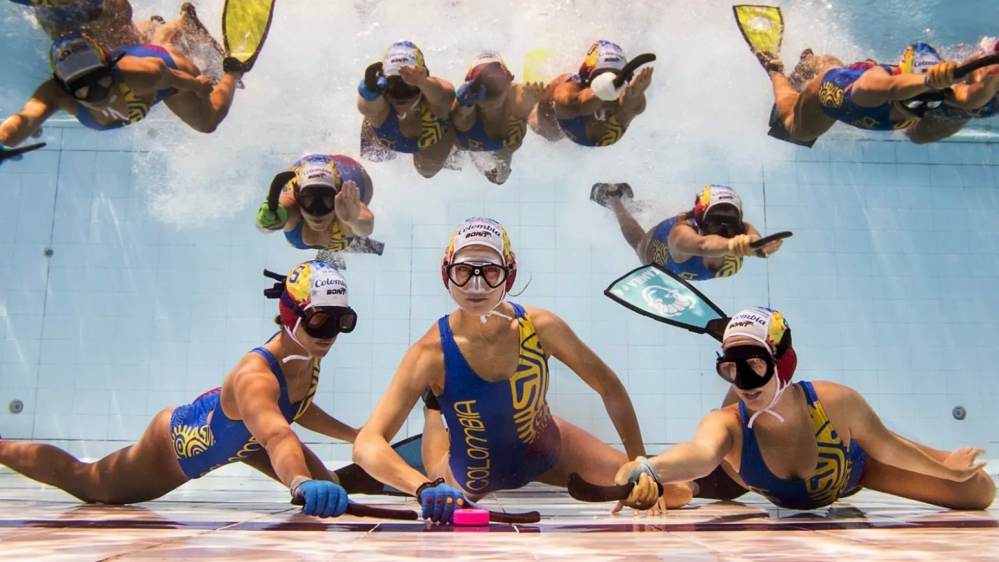
After the British Navy invented this sport in the 1950s to keep their divers fit and improve their underwater efficiency, it has evolved into a fast, dynamic sport now played in more than 50 countries worldwide. In the San Francisco Bay Area, it started in 1976; that team became Treasure Island Divers. The first World Championships were in 1980 in Vancouver, BC, but only men played; almost immediately, Worlds included women’s teams, and until very recently, were scheduled every two years.

Meet a World Expert Referee
I first heard of this sport when I joined the Sierra Club in San Francisco in 1986 and was surprised to hear that they had a team. While I never played because I cherish my teeth, I called Carol Rose in Sonoma, California, who’s been the President and Secretary of the Central California Council of Diving Clubs, Inc. for 30 years. This recreational diver membership organization is one of 15 dive councils operating under the wing of the Underwater Society of America (USOA).
Carol said, “I married a diver, got NAUI certified in 1973, but had to give it up in 2005. Along the way, I was an underwater hockey referee for about 20 years and got to travel the world multiple times. It’s a fascinating sport: the only one that requires you to hold your breath the entire time you’re in the underwater field of play, and it’s the only three-dimensional sport, as you play above, below, or beside other swimmers. It may also be the world’s worst spectator sport, but it’s been growing in popularity for 70 years.”
But she’s being modest. Carol evolved into a world-class underwater hockey referee who was on the deck for thousands of games, including local, regional, national, and global. She was even the Chief Ref for eight international tournaments and eight world championships, served as Secretary for the World Underwater Commission for 17 years, was on the Underwater Hockey Commission, and was President of the USOA. Because of all this, Carol earned a Lifetime Achievement Award from the World Underwater Federation in 2016 and was inducted into, and was founder of, the Women Divers Hall of Fame in 2000.
“I was reliable and a pretty decent ref,” she added. “But it’s mentally exhausting to follow 12 players and three refs in the water at all times. I would do two games in a row, then rest by taking two off, so I could do so many games in those tournaments.
In her limited spare time, Carol wrote a few books that are no longer in print: “How to Form a Dive Club” and “How to Start UW Hockey”.
Paid Advertisement
A Retired Female Hockey Player
I also spoke with Jennifer Kimberly, a diver in Santa Rosa, CA, who was certified in 1979 and became an instructor in 1981. “I started playing in 1980, became the Club Puck team captain, and really enjoyed it for about 10 years. I even traveled to a few tournaments––in Chicago, Florida, and Australia. We played once a month, width-wise, in an Olympic pool on Treasure Island in the middle of San Francisco Bay and all over the Bay Area. Then I played again from 2019 to 2020.
“It kicks your ass. You’re out of breath for two hours with 30-second dives. The shallow end is like a bunch of piranhas, where I once got a black eye. You’re almost invisible underwater when you’re good at it. Underwater hockey can also be cold, especially at night. But it makes you such a good skin diver.”

The Equipment You’ll Need
According to Cen-Cal’s website, “The two teams vie to move the puck into the opponent’s goal, which is three yards long and has a trough along the back into which the puck must land to score. Players wear fins, a divided-lenses mask, a snorkel/mouthguard, headgear, a team bathing suit, and thick, silicon gloves to protect their hands. The puck may only be moved by pushing a short black or white hockey stick that each player holds. Each team consists of 10 players, six of whom may be in the pool at any time; there is no goalkeeper. Team categories are Under 19, Open Men’s, Open Women’s, Coed, and Masters.”
The Teams
Club Puck, located in Los Gatos, California, is one of the largest in the U.S. Here’s a list of American teams and contacts. Find a club near you.
The Championships
The Underwater Hockey Intercontinental Championships are a series of three competitions for international teams held every four years and are split into three regions––North and South America, Europe and Africa, and Asia and Oceania. Read more at World Underwater Federation. Its2026 CMAS 7th World Championship is planned for Gebze/Kocaeli, Turkey, on July 16, 2026.
The Bottom Line
Underwater hockey is fun, great aerobic exercise, improves your skills, and builds camaraderie. There are now teams in 23 U.S. states, with eight in California. By hosting an underwater hockey team at a local pool or having your employees join a team, it’s also a great way to promote your dive shop to dedicated swimmers, divers, and snorkelers, who’ll buy their hockey gear and branded team uniforms from you.
To find out more about underwater hockey, contact Carol Rose, or email gil@zeimer.com
Paid Advertisement

Click here to read this article on our Flippingbook platform.
More from This Issue:
APRIL 2026 ADVERTISING PARTNERS











RECENT ISSUES



MAGAZINE TOPICS