

Dive Shop Accounting 101: Review the Basics

by Jeff Cinciripino, JeffCinciripino.com, Former Owner of Scuba Shack, Rocky Hill, CT
Click here to read this article on our Flippingbook platform.
I HAVE TO ADMIT I HAD FOA. I had a fear of accounting. I would pick up a book on accounting principles to try to overcome that fear only to get to page 2 and be completely lost. I was financially challenged with double-entry bookkeeping. I couldn’t quite understand the notion of debits and credits. Sure, I could comprehend the words debit and credit but when it came to accounting principles, they seemed to defy logic, at least from my perspective. As a small business owner, I needed to overcome that fear. Understanding debits and credits was imperative as I took on the role of bookkeeping for the dive shop.
As Joe Walsh once sang, “I’ve got accountants that pay for it all” and most small businesses have accountants. We know that accountants can be expensive given their knowledge and expertise. There is another aspect of accounting that can also be expensive; bookkeeping. Even if you are fortunate to have the resources to utilize a bookkeeper, there is value in understanding some of the basics of sound business bookkeeping.

That balance sheet is one of the fundamental tools that we use to measure the health of any business. To accurately reflect the company’s financial position, the balance sheet depends on meticulous bookkeeping. We use the following equation to construct the balance sheet:
Assets = Liabilities + Owner’s Equity
Assets, liabilities, and owner’s equity are made up of many different accounts. The complete list of these accounts is known as the chart of accounts that we maintain in our general ledger. Detailed bookkeeping for each one of these accounts is absolutely necessary to properly reflect your business’s financial position.
Paid Advertisement
Let’s start with how each account is constructed. The simplest form of each account is known as the “T” account because when depicted it looks like the letter “T”. The top is the account name and number with the left side representing the debit side while the right is the credit side.
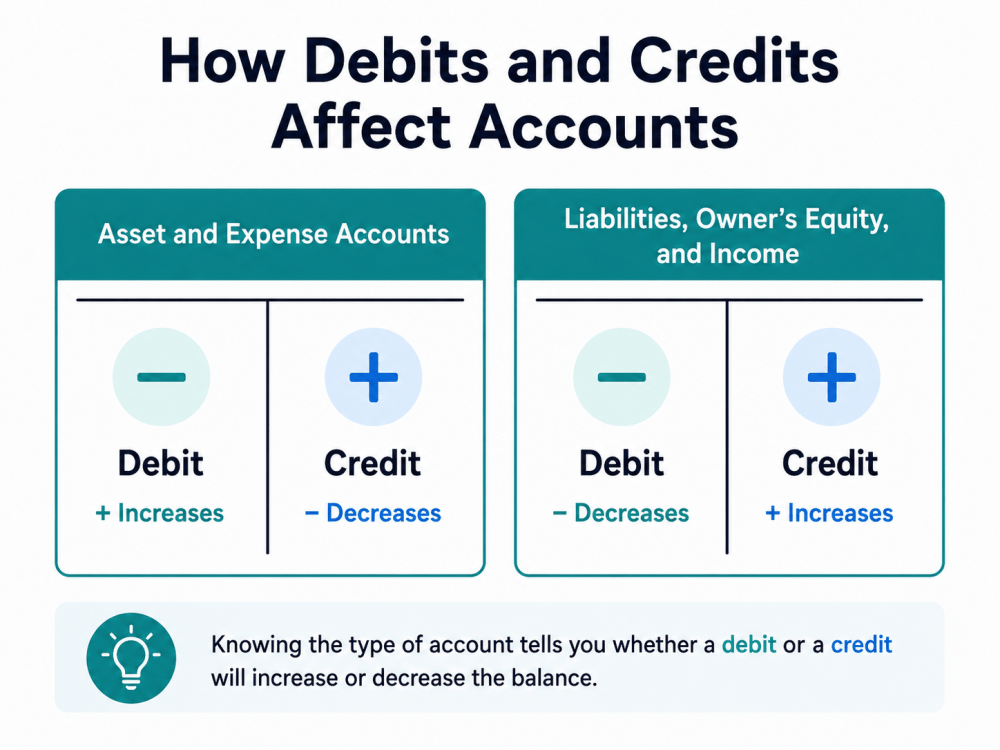
Now the basis of bookkeeping is the double-entry system. For each debit there needs to be a corresponding credit in a specific account. This is where I struggled with keeping my debits and credits straight because debits and credits are applied differently depending on the type of account. Sometimes a credit will increase the value of an account and sometimes the credit will lower its balance. The illustration to the left summarizes the rules for how the debit or credit is applied.
All of the individual accounts your business creates are called the chart of accounts and you can have a lot of them. By classifying the account (Asset, Expense, Liability, etc.), we now know how to apply a debit or a credit. The complete set of accounts is also called the ledger and entries into the ledger are also known as journal entries. It is worth working through an example that clearly shows how this double-entry bookkeeping works.
We’ll start with example 1 with your business purchasing a regulator for $1,000 wholesale from your manufacturer. So, we will need to take the money from our checking account and add the $1,000 regulator to our inventory.
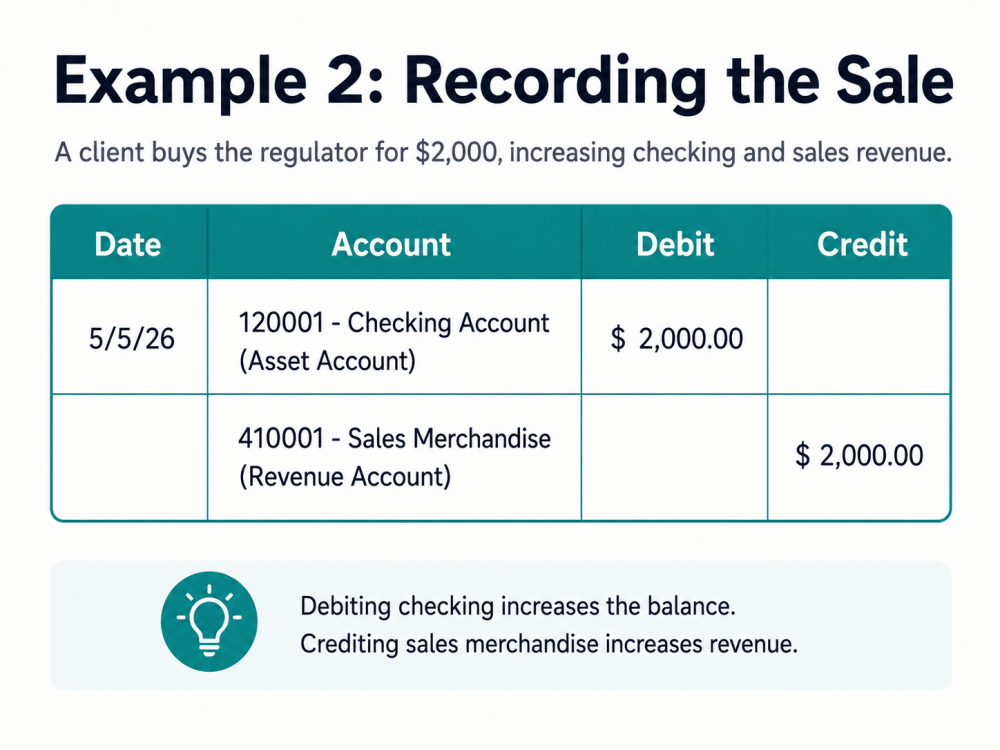
A few days later, one of your clients comes in and purchases that regulator for the retail price of $2,000. (Let’s ignore sales tax for now). Therefore, we need to add cash to our checking account and register the sale in our system. Example 2 shows the entry for that transaction.
Debiting the checking account actually increases the balance. Additionally, when we credit the sales account, we are also increasing it.
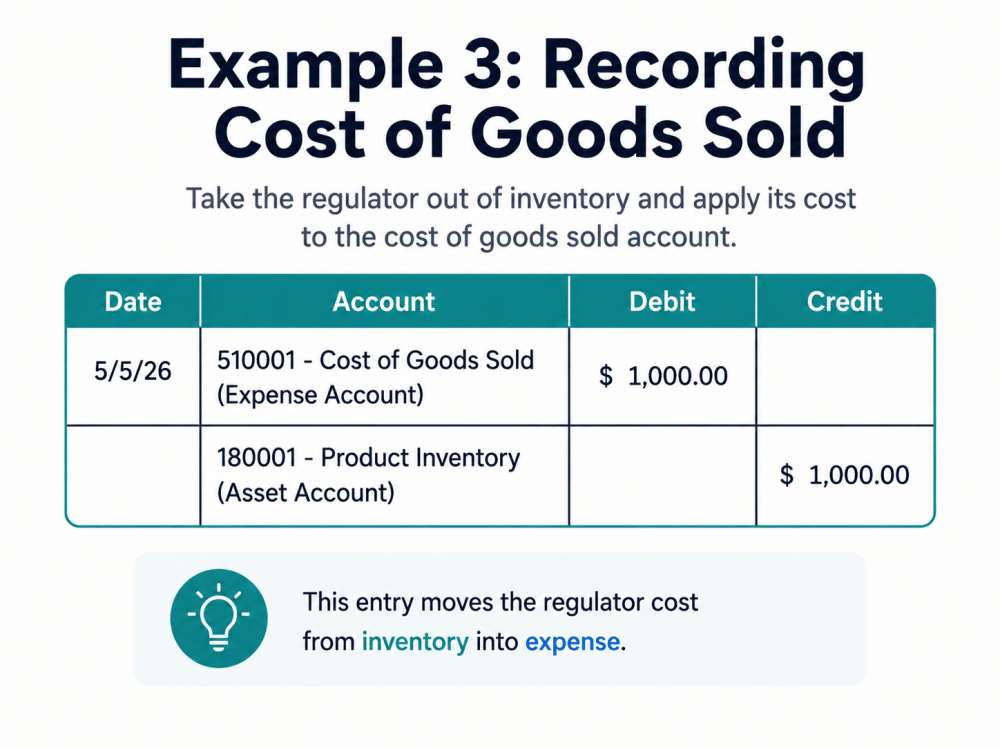
Finally, we need to take the regulator out of inventory. We do that by applying the cost of the regulator to our cost of goods sold account – example 3.
Fortunately, we have powerful accounting systems, like QuickBooks Online and others, that will properly apply the debits and credits in most cases.
A dive retailer’s passion is scuba diving; whether it is teaching new or experienced divers, equipping them with proper gear, or taking them on amazing dive trips. Dive shops are also businesses that require an understanding of a host of business processes including sound bookkeeping and accounting. By understanding how to keep your debits and credits straight, you just might start to get over that fear of accounting. Reference: Lerner, J. (2007). Theory and Problems of Bookkeeping and Accounting (4th edition). McGraw-Hill.

Paid Advertisement

Click here to read this article on our Flippingbook platform.
More from This Issue:
May 2026 ADVERTISING PARTNERS














Watch the Interview on Level Up for this issue:
Watch the Level-Up: From Behind The Counter Interview:
RECENT ISSUES




MAGAZINE TOPICS