

A true safety-first dive professional delays or cancels dives when weather margins narrow, even when equipment is loaded and divers are eager

SAFETY IN PROFESSIONAL DIVING is rarely defined by dramatic interventions or emergency mastery. Instead, it is revealed through a steady pattern of conservative, deliberate decisions made long before risk becomes obvious. The safety-first dive professional understands that most accidents are not caused by a single failure, but by a series of small choices that erode margins or by normalizing poor or incorrect behaviors. Preventing those failures and shortcuts is the true mark of safety-first dive professionalism.
This safety-first mindset begins before the diver ever reaches the water. Safety-focused professionals prepare early and thoroughly, understanding that rushing is often the first link in the incident chain. I encourage you to revisit my article from the January 2026 issue of Scuba Diving Industry Magazine, “The Rule of Three: The Principle of Error Recognition and Critical Rethinking.”
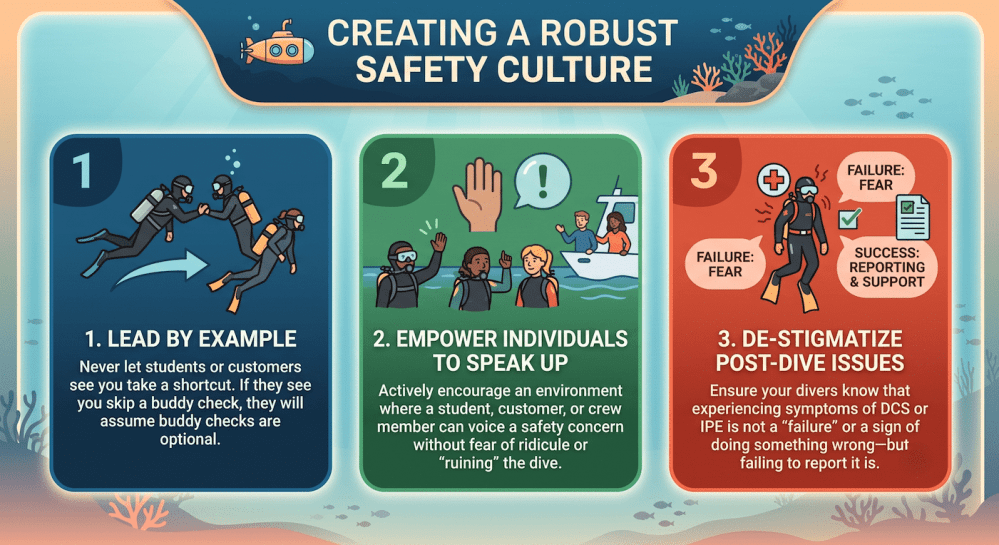
A true safety-first dive professional delays or cancels dives when weather margins narrow, even when equipment is loaded and divers are eager. They analyze their own breathing gas rather than assuming correctness of someone else’s analysis, review site specific hazards regardless of familiarity with the dive site and select exposure protection based on worst-case conditions rather than optimism. These decisions are not dramatic, but they are decisive. They acknowledge that conditions or circumstances do not improve simply because schedules demand it.

A safety-first dive professional serves as the vital benchmark for diving and industry standards, directly influencing the behavior and habits of customers and developing divers alike. When an instructor or divemaster meticulously executes pre-dive safety checks, respects depth and time limits, and demonstrates flawless buoyancy control, they transform abstract safety rules into concrete, non-negotiable practices. Divers, especially beginners, instinctively mirror their leader’s behavior; if a professional takes short cuts or exhibits complacency, students quickly learn to treat safety protocols as optional. Conversely, by consistently embodying a culture of risk management and environmental awareness, a role-model dive professional fosters a mindset of situational awareness and mutual accountability, ultimately reducing accidents and preserving the well-being of the entire dive community.
Equipment choices further reflect this approach. Safety-first dive professionals resist the temptation to test new configurations on customer or student recreational dives. They choose familiar, well-maintained equipment, assembled with intention and checked without distraction. Hoses are routed to minimize entanglement risks, accessories are secured, and redundancy is carried out quietly and purposefully. A backup mask, a dependable cutting tool, or a properly placed or deployed surface marker buoy (SMB) are not symbols of distrust in one’s own ability; they are acknowledgments that failures occur without warning and options must be readily available.
Paid Advertisement
During pre-dive briefings and dive planning, safety first dive professionals listen carefully and ask clarifying questions without challenging authority or derailing procedure. They ensure that dive plans are realistic, breathing gas reserves are calculated to allow assistance to others, and turn pressures are established and respected. They choose buddies based on recent diving experiences, communication styles and compatibility rather than certification cards alone. These decisions are grounded in the understanding that the best diving companions are not necessarily those who talk most about their experience, but those with the greatest shared awareness.
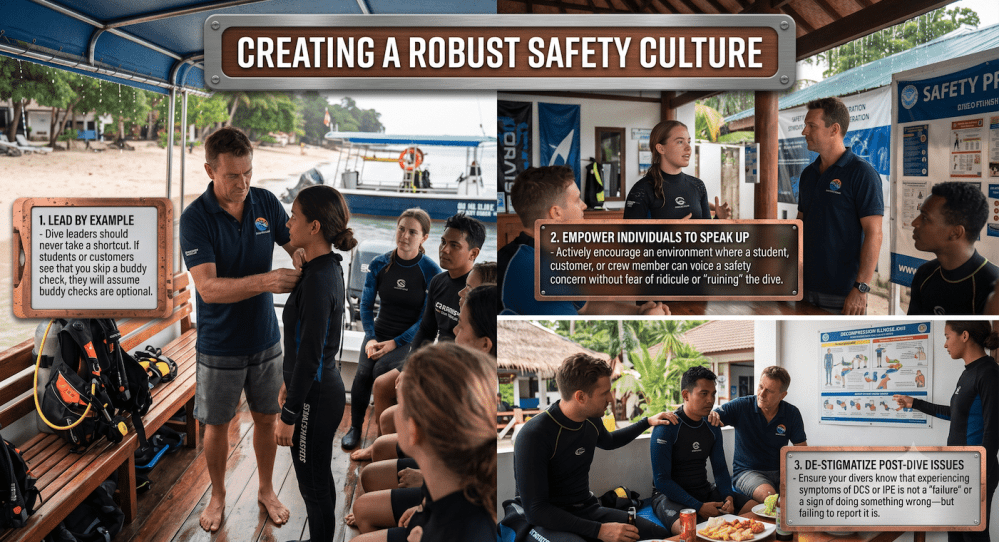
Underwater, safety-first decisions continue quietly. Safety-first dive professionals monitor more than their own gauges; they observe the environment and the behavior of those around them. They recognize early indicators of stress, confusion, or fatigue and respond appropriately before they escalate. When conditions change, visibility deteriorates, currents increase, or equipment behaves unexpectedly, they adjust the dive plan or call the dive without hesitation. Deploying a surface marker buoy early, choosing a controlled ascent away from congestion, or aborting a dive due to a minor irregularity are all expressions of judgment, not caution taken to excess.
Perhaps the most defining characteristic of the safety-first dive professional is the willingness to call a dive early. There is no embarrassment in discretion, and no requirement to justify conservative choices. Calling a dive because a diving companion appears uncomfortable, because an ascent line is crowded, or because conditions differ from expectations is not a failure to succeed; it is success defined correctly. Safety-first dive professionals, adopting a ‘no-fault’ dive termination philosophy, understand that every diver surfacing unhurt from an uneventful dive is the true measure of success
Responsibility continues after surfacing. Safety-first dive professionals remain attentive during surface intervals, assist when needed regardless of their own dive schedule, and share safety relevant observations with crew discreetly and constructively. Near misses are noted, not dismissed. Lessons are carried forward. The goal is not to assign fault, but to strengthen systems and habits.
What unites these decisions is not complexity or novelty, but consistency. Each choice preserves the appropriate margin of safety. Each choice reduces reliance on luck. Each reflects an understanding that professionalism is measured not by how problems are handled, but by how rarely they occur.
In the end, the safety-first dive professional is often unnoticed. Their dives are calm. Their teams feel secure. Incidents are rare, and when they occur, they are managed efficiently and without escalation. This outcome is not accidental. It is built one decision at a time, guided by the simple principle that in any form of diving, safety is never negotiable and never optional.
Note: The information presented here is for general informational and educational purposes only and is not intended as medical advice. Readers should consult a qualified healthcare professional regarding fitness to dive or any medical concerns resulting from a dive.
Paid Advertisement


Click here to read this article on our Flippingbook platform.
More from This Issue:
THIS MONTH’S ADVERTISING PARTNERS














RECENT ISSUES




MAGAZINE TOPICS