

In a nutshell, CO is odorless, tasteless, and potentially lethal.

CARBON MONOXIDE (CO) poisoning should be taken seriously! I know from personal experience. What might be thought of as “just a little CO” in a scuba tank can quickly become life-threatening, even in very shallow water. At depth, even small amounts of CO can become deadly because it binds to hemoglobin 200 to 250 times more readily than oxygen, thus greatly reducing our blood’s ability to transport oxygen to vital tissues.
In a nutshell, CO is odorless, tasteless, and potentially lethal.
Even in cases in which a victim survives, exposure to CO can have serious lifelong consequences far beyond just ending your diving career.
I believe that issues resulting from CO in scuba tanks are likely to be far more common than our industry has believed they were. The good news is CO poisoning and the resulting issues are preventable.
The Reflexive Response: My CO poisoning incident occurred in 2008. In the years that followed, whenever I shared my story with my diving peers, those I was talking with almost always stopped me and asked if the “compressor exhaust valve was too close to the intake valve.”
No doubt about it, their suspicion is one way CO can enter a scuba tank.
But the fact is, those are not the only factors that cause CO to enter a scuba cylinder.
I am not a doctor, an EMT, or an expert on compressors or compressor maintenance. Numerous other factors that can cause CO to be in a scuba tank include failure to properly maintain a compressor, using the wrong oil, using the wrong filters or a compressor that overheats.
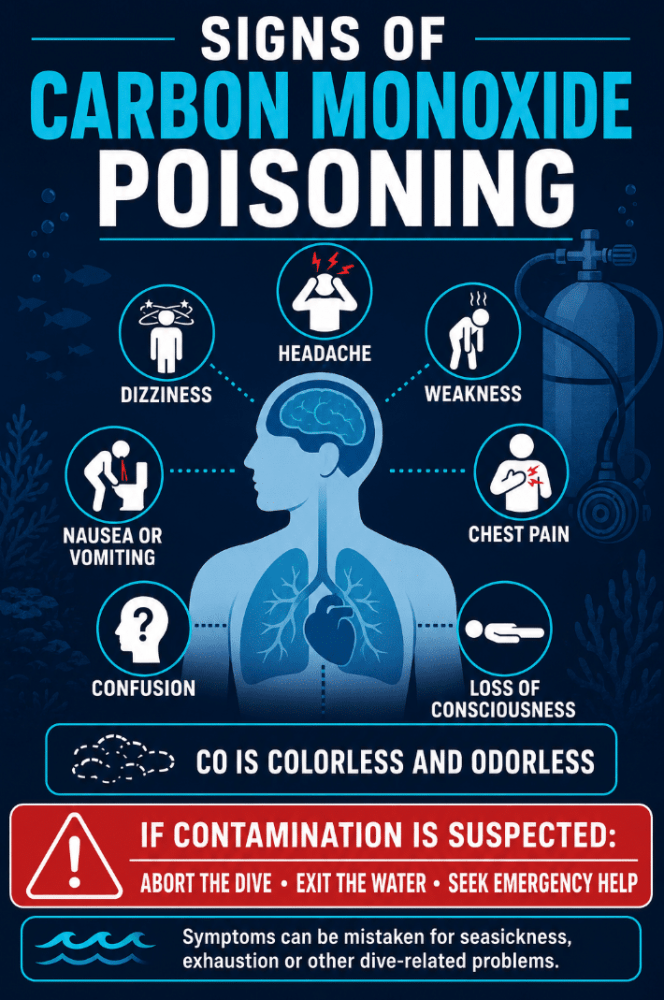
Remember, CO is odorless and tasteless. Unless you check the gas in a scuba tank before you inhale it, you have no way to be sure the gas is not contaminated with CO.
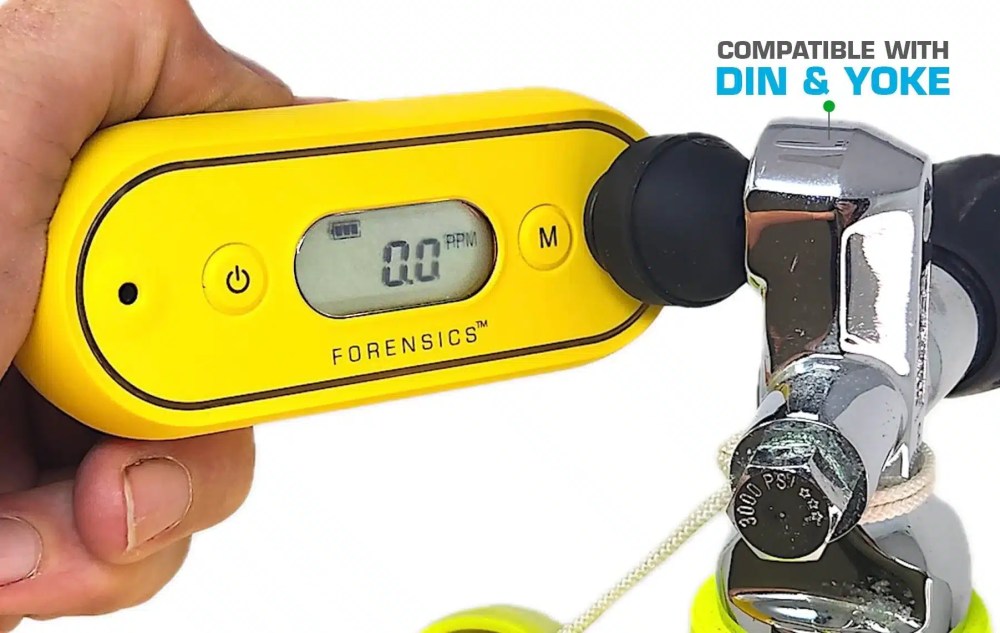
The good news is there are small, portable CO analyzers made to detect a low number of parts per million of CO. Be aware, some CO monitors are designed to be useful in detecting CO in your home, hotel room or garage. They tend to be less sophisticated and not useful when it comes to detecting low concentrations of CO that can prove fatal to divers.
Analyzing for CO is as easy and fast as analyzing a Nitrox mix. I purchased my CO analyzer through Divers Alert Network (DAN). I will use it to verify that the gas in my tank is free of CO in every tank I ever use for the rest of my diving career. You can buy a CO analyzer by going to the Divers Alert Network website at DAN.org > store, and entering “CO analyzer” in the search bar.
Some people are quick to say the dive operator should analyze the gas they put into a tank. I wholeheartedly agree. But as with Nitrox, so should the diver who uses the tank. We need to take responsibility for our own safety and the safety of those we dive with.
My Story: Until recently, when I have shared my story with my diving peers I usually felt like my incident was not received with the concern I thought and hoped it would be.
Recently, follow-up conversations with a friend who along with numerous shipmates experienced a CO hit on a dive charter boat have made me realize that I shouldn’t give up on sharing my experience and what I have learned about CO poisoning.
My incident was not the result of the exhaust valve of the compressor used to fill my tank being too close or downwind from the intake valve.
Recent conversations with a friend who had suffered a ‘CO hit’ led me to make a Facebook post about the fact that I recently purchased and now use a CO monitor, and almost 300 people reacted, commented, or shared stories of their own CO incidents on my post.
There have likely been a lot more CO poisoning-related incidents than we recognize. Many involved causes unrelated to the relative positions of the intake and exhaust valves on a compressor. Most had to do with poor maintenance, a compressor that overheated, and some unknown reasons. Many were nuanced.
One shared story that got my full attention involved a friend I worked with in a dive center in the 1970s. He later owned his own dive shop in the Marshall Islands. Late one night after a long diving day, he was filling tanks. He thought that four tanks on whips needed about 15 more minutes to get filled and that his compressor had about 15 more minutes worth of gas before it shut off.
The next morning when he arose, the tanks were filled and nothing about the compressor garnered his attention. He rented the tanks.
A few hours later four divers were in the hospital with CO poisoning. They were lucky to be alive.
So, what happened? The unattended compressor threw a rod and overheated but continued to fill the tanks. The overheated oil released CO that entered the tanks. By morning, the compressor had cooled down, and my friend was completely unaware of what happened until later when he went to fill additional tanks. Eventually, he unraveled the chain of events.
You can easily blame my friend for going to bed and assuming everything would be okay. You can blame him for assuming everything was perfectly normal in the morning when the tanks were full and the compressor had cooled down.
But, if the divers had a CO analyzer like those that are readily available today, they could have checked their own tanks and prevented their life-threatening incident. That is the takeaway message I hope to impart.
This brings me back to my story: I was on a liveaboard for back-to-back week-long trips. On the first dive of the second week, I was diving in a 3-person buddy team. Only minutes into our dive, I felt strange. No doubt, conditions were bleak, but I was only 22 feet deep. I settled onto the sea floor and held still because I was having difficulty catching my breath. After stopping, I felt better and the difficulty in catching my breath dissipated. Then a small shark swam in front of me. I swam slowly toward the shark, but as soon as I started to move, I had trouble catching my breath. I was breathing hard but felt like I wasn’t getting any oxygen. It felt similar to breathing when hiking hard at altitude and like when I breathed a rebreather until my scrubber crashed so I could learn what that was like. Stop moving and all was good. I started swimming, even slowly and with very little effort, and I couldn’t catch my breath. I signaled my buddies that I needed to call my dive.
They swam back to the boat with me, watched me ascend to the swim step, and went on their way. As soon as I reached the surface I asked for help. The crew assisted me up the dive ladder and I passed out on the swim step.
The crew removed my gear and carried me into the salon. Roughly 40 minutes later I heard a crew member on the deck shout to the crewman that was assisting me that he needed help on the swim step. I immediately suspected that we had a ‘gas problem.’ In my brain fog, I told the crew to get everyone out of the water.
I later learned that one of my dive buddies had to be rescued almost 50 minutes into his dive. The diver who rescued him dropped his weights and got him back to the boat. The rescued diver didn’t remember being rescued, but without help he almost certainly would have died.
So, what happened? Only five divers made the last dive of the first trip. The diver who had to be rescued and I were in that group. I made a long dive on the last dive of the first trip. The diver who needed to be rescued only dived for 10 minutes or so due to the deteriorating conditions.
All tanks except those used by the five divers who made the last dive of the first trip got filled before we returned to port. In port, work was done on the compressor. After the work was completed, the five tanks used on the last dive were filled. Only two of those tanks, mine and the one used by the diver who got rescued, got used on the first dive of the second week. Our buoyancy compensators and regulators remained on our tanks, so we absolutely knew which tanks were ours. My tank needed a good fill. The tank used by the rescued diver only needed to be topped off.
On the first dive of the second week, my problem occurred minutes after I entered the water, as my tank was almost completely filled after the work was done on the compressor. The diver who needed to be rescued did not experience his problem until almost 50 minutes into his dive. His tank had only been topped off after the compressor had been worked on.
Paid Advertisement
Both of us suffered CO poisoning. Improper compressor maintenance, overheating, and the use of the wrong filters were all determined to be contributing factors.
Including so many details regarding why some CO hits occurred is to illustrate that understanding the causes and addressing them before an incident takes place is challenging to say the least.
The good news and main point I want to make is that had any of the divers involved monitored their own tank for CO, the incidents could have easily been prevented.
Thoughts Regarding Two Big Mistakes: During the first week of my trip a nasty flu had gone around the boat. Luckily, I didn’t catch it and neither did my dive buddy, but most others did. Rather than suspect the gas, the crew decided my buddy and I had the flu, that our incidents were not gas-related as I suggested. The crew put us in bed. I slept for 18 hours. I remember people checking on me, but in all seriousness, when I awoke the next day, there was no need to make my bed. I literally had not moved. I was physically exhausted, as exhausted as I have ever been in my life. That is what CO poisoning does. My body was oxygen starved.
The mistake of assuming we had the flu led directly to the second mistake. We were never administered oxygen. That was a HUGE MISTAKE. We should have been given 100% O2. That is ALWAYS the recommended course of action. Put divers on 100% O2 anytime there might be a respiratory-related or pressure-related issue. “Might be.” That’s the key. Properly administered O2 might help and can never hurt.
I insisted that the tanks my buddy and I used be analyzed by a professional lab. The boat used its back-up compressor for the rest of the trip. The lab report indicated that my tank was extremely high in CO, CO2, and hydrocarbons.
I wrote an article for Dive Training magazine about my experience. A doctor in Canada read the piece. He called and told me he knew of nine similar incidents. In one, seven divers died.
Roughly 10 years later and ironically at a party at DEMA, my world suddenly went “upside down.” My heart started to race. I broke out in a sweat. I couldn’t tell if I was walking in a straight line. My legs felt extremely heavy. I needed to sit down, and I needed help getting back to my room. With a repeat episode the next day, I flew home to see my doctor. I called DAN because some of my symptoms were similar to those I experienced in the days and weeks after my CO incident.
The next six weeks were hellish. I saw an audiologist, cardiologist, neurologist, and a handful of other “ologists.” I underwent blood work, MRIs, and CT scans. My body was poked and prodded, as it should have been. Doctors questioned whether I had experienced a seizure and tried to induce one. Had they been successful, my diving days would have been over. My driving days could have been over as well. It was a very trying time.
Ultimately, it was determined that I have an unusual form of migraine that is caused by light my brain doesn’t process the same way most brains do. The doctors at DAN could not unequivocally state that CO poisoning is the cause, but they did tell me they knew of enough similar cases to say there is a statistical correlation. The takeaway message is that CO poisoning can cause permanent cognitive, motor and other deficits days, weeks, or even years after exposure.
It is likely that CO caused me to experience the issues I experienced at DEMA years after my initial exposure. I’ll never know with absolute certainty. Luckily for me, my symptoms seem to be manageable. Some people have far more serious issues for the remainder of their lives.
For me, the remedy to date, as suggested by the medical experts at DAN, has been to wear polarized sunglasses whenever I feel the onset of an event like the one I experienced at DEMA. It has happened a handful of times over the years. Thankfully, the polarized sunglasses have done the trick, and in my case the symptoms have quickly disappeared.
Closing Thoughts: For one day in my life, I was the luckiest unlucky person on the face of the Earth. CO contaminated my scuba tank. I could easily have died, but I was able to get back to my dive boat and get help before I passed out. Thank my lucky stars!
As Dalton’s Law dictates, the partial pressure of a gas increases with depth. This means even tiny, trace amounts of CO inside a diving cylinder that might be harmless at the surface can quickly become toxic or fatal as a diver descends and the partial pressure of the contaminant increases.
As that diver ascends, the partial pressure of oxygen (PO2) drops rapidly. Because CO binds to hemoglobin so efficiently and forms carboxyhemoglobin (COHb), the body’s remaining oxygen transport capacity can be severely deficient. The sudden drop in available oxygen during ascent can cause an immediate blackout before the diver ever reaches the surface. That did not happen to me. Thank my lucky stars!
I should have been given 100% O2. In the short run, I probably would have recovered much faster with fewer long-term issues.
My CO event might well have resurfaced later in my life with conditions that are still ongoing. They could be worse, and someday they might be. If that is the case, I might never know the issues are related to a CO incident from years earlier.
Had I known I could analyze the gas in my tank for CO, I like to think I would have. But I did not. Going forward I will use a CO analyzer to check for CO in every tank I ever use, no matter what the gas is supposed to be. That is something I need to do to be responsible for myself, my friends and family, those I dive with, and the diving community at large. I will also do what I can to encourage others to analyze their breathing gas before every dive. I hope you will join this effort.
Author’s Note: I would like to thank Dan Orr, Stephen Frink, and Dr. Jim Holm for sharing relevant information enabling me to be more precise regarding the information in this piece. And I’d like to thank DAN Drs. Jim Chimiak, Karen Van Hoesen, and Ian Grover for helping save my diving career. I am grateful to all.
Paid Advertisement

Click here to read this article on our Flippingbook platform.
More from This Issue:
THIS MONTH’S ADVERTISING PARTNERS














RECENT ISSUES




MAGAZINE TOPICS