

category: Retailing (8 min read)
sponsors: Barefoot Cay Boutique Resort Roatan, Clear Story Coach
How to Blend The Physical & Digital in Your Dive Store

by Cathryn Castle Garcia, Owner, ClearStoryCoach.com, The Azores
THERE’S A LOT OF TALK THESE DAYS about AI replacing all our jobs. While it’s true that Miso Robotics’ Flippy 2 robot can produce hot, delicious, perfectly crispy French fries faster and more reliably than a human operator, the diving industry can mark itself safe from being overtaken by bots. Why? Because the retail dive industry’s supporting pillars of education and instruction, equipment, and real-time experience require that we real, live humans engage with customers in ways that Artificial Intelligence and robots simply can’t.
The Pillars
Unlike many retail categories, scuba diving cannot exist purely online. Certification programs require our customers spend time with us in academic and in-water training sessions. Equipment requires our expert fitting and servicing, and scuba cylinders can’t get filled without us. The experience of scuba diving has human connection hardwired into it, with the instructor/student relationship and the buddy system. Training, equipping, and real-time experience – actually going diving – are foundational pillars upon which our industry stands.
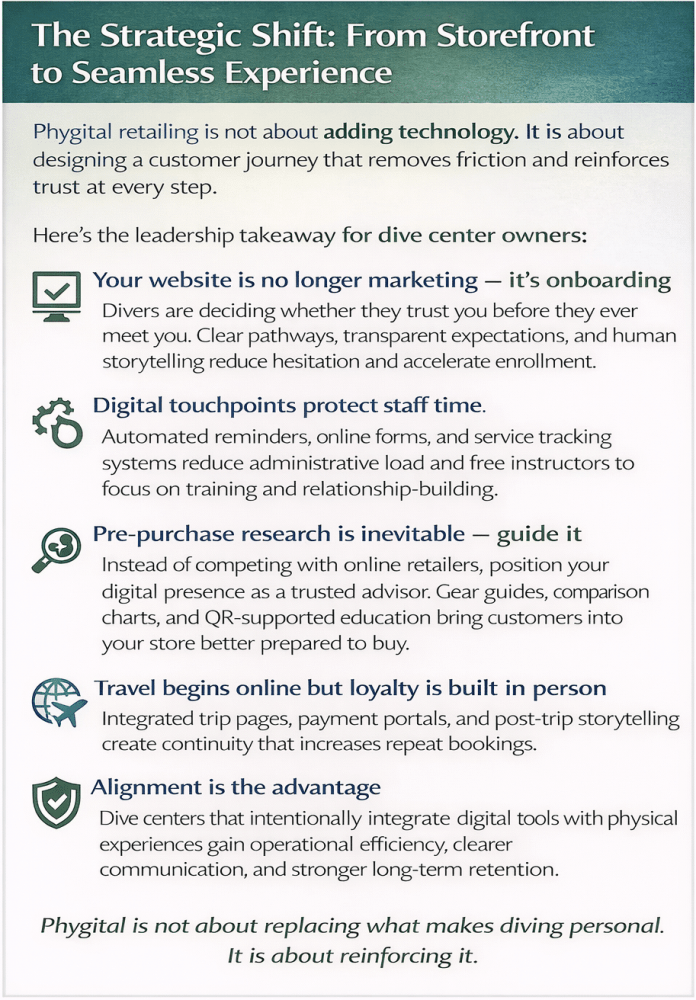
Today’s divers begin, evaluate, and often decide their next step long before they set foot in a retail dive center. This is where “phygital” retailing comes into play.
Phygital retailing (physical + digital = phygital) describes the intentional blending of in-person experiences with online and digital tools to create a seamless customer journey. For retail dive centers, phygital retailing is not about replacing face-to-face, personal interaction with whizz-bang technology. It is about using digital tools to enhance clarity, convenience, and connection, while preserving the irreplaceable value of relationship building, which happens when we provide in-water training and in-store expertise. When we do phygital right, we add another pillar of support and stability to the business of training and equipping divers.
What Phygital Retailing Is and Isn’t
Phygital retailing is not about replacing instructors with videos or competing with large online retailers on price. It is not about adding technology for its own sake or running disconnected online and in-store operations.
Paid Advertisement
Instead, phygital retailing is about intentional integration. Each digital tool should make the physical experience clearer, easier, or more valuable.

At its core, phygital retailing acknowledges a simple truth: modern customers move fluidly between online and offline environments. A diver may research gear on a website, read reviews on a phone, ask questions in your dive center, complete training in a pool, and book a trip online – all as part of one continuous experience.
For dive centers, phygital retailing means designing systems where digital touchpoints support physical ones rather than competing with them. The goal is not more technology, but better alignment between how customers learn, buy, and participate.
Dive centers are uniquely suited to phygital strategies because scuba is experiential by nature. No website can replace the sensation of a first breath underwater, but digital tools can remove friction before and after that moment.
Phygital retailing helps dive centers:
- Outline clear expectations before training begins.
- Reduce administrative workload for staff.
- Build trust prior to major purchasing decisions.
- Stay connected with customers between dives.
Your Website as a Phygital Resource
Most divers discover a dive center online, through social media and by visiting the business’s website before visiting in person. When your digital messaging is clear and human, customers arrive at the dive center more confident in the services you provide, and they show up better prepared to begin doing business with you.

To put your best phygital foot forward, your website needs to:
- Put the customer first. Instead of making your website about you and the services you offer, use language that is about the benefits your customer will experience, and how happy they’ll feel when they do business with you.
- Clearly explain the training pathways the customer will embark on, and what they’ll learn along the way.
- Introduce you and your dive center staff with bios and photos that position your team as experienced, thoughtful, and caring guides.
- Have prominent “Learn More” buttons and easy-to-use online inquiry and scheduling forms.
- Feature “Transformation” stories and photos from clients who’ve enjoyed doing business with you and can encourage others.
Digital Learning Meets In–Water Experience
Training is one of the strongest opportunities for phygital integration. We’re already using eLearning platforms, but the true advantage comes from how those tools are supported.
Getting phygital with diver training can include automating key student touchpoints that save you and your staff time while also making sure you’re consistently reaching your customers. Examples include:
- E-reminders for pool and open water training dates.
- Downloadable checklists that outline required gear and class preparation steps
- Post-certification emails that offer proposed next steps in scuba training and travel.
Phygitally Cultivating Equipment Sales
Scuba equipment is rarely an impulse purchase. Divers often research extensively before committing. Phygital retailing can help cultivate in-store equipment sales when your business offers:
- Online gear guides, size charts, and recommended buying pathways.
- Product comparison resources that list features and benefits of gear.
- QR codes linking to YouTube videos on equipment setup, use, and care.
- Digital receipts with service and maintenance reminders.
By supporting pre-purchase research digitally and delivering expertise in person, you can position your staff as trusted advisors rather than transactional retailers.
Paid Advertisement


Simplifying Service and Maintenance
Equipment service depends on reliability and communication. Phygital tools help maintain consistency without sacrificing personal connection. Phygital service strategies may include:
- Online service booking.
- Automated inspection and service reminders.
- Digital service histories tied to customer profiles.
- Follow-up emails explaining completed work.
Automation enhances your professional image and helps your customers reduce missed service intervals. When your business earns a reputation for always thinking about its customers, you become valued. And trusted.
Digital Travel Inspiration, Real–World Adventure:
Dive travel is inherently phygital. The excitement often begins online, while the memories are made in person. Start the digital storytelling before the trip and it’ll drive sales. Continue it after the trip and it can increase repeat business.
Effective approaches include:
- Trip landing pages with itineraries and FAQs.
- Virtual information sessions or recorded briefings.
- A convenient payment portal for online deposits and payment plans.
- Post-trip photo sharing and testimonials pages and YouTube videos.
- Automated “Let’s Do It Again” travel offers.
Online Connection, Physical Belonging
Successful dive centers function as community hubs. Digital tools support real-world relationships and help maintain engagement. Ways you can create a phygital buzz include:
- Email newsletters and private social groups.
- Online event calendars synced with in-store activities.
- Digital loyalty programs tied to physical purchases.
- Automated “flash sale” invitations to visit the dive center.
- Automated follow-ups after certification or travel.
When executed well, phygital retailing improves customer confidence, and strengthens long-term loyalty. It allows dive centers to cultivate personal connections.
In a phygital world, clarity becomes a competitive advantage. When divers know what to expect online and feel supported in person, trust deepens. And in the dive industry, trust is what keeps people learning, buying, traveling and diving.

Click here to read the full article on our Flippingbook platform!











RECENT ISSUES




MAGAZINE TOPICS