

How Retailers Can Be a Part of the Solution

by Kramer Wimberley, Board of Directors & Founder of DWP/DWP-CARES
IF YOU ASK THE AVERAGE PERSON where oxygen comes from, they will likely point to the nearest tree. We have been conditioned to see forests as the “lungs of the planet. ” But the scientific reality is that the vast majority of our oxygen – between 50% and 72% – is generated by the sea. Our oceans are the true lungs of this planet. Yet there is a profound disconnect: we cannot expect a generation to protect an ecosystem they are afraid to touch.
Across the United States, we are witnessing a quiet but devastating policy shift within our educational systems. In response to the tragic reality of youth drowning, many school districts have adopted an “avoidance-based” safety model. To limit institutional liability and insurance exposure, the solution has been to simply keep children away from the water.
While this might protect a school’s bottom line, it abandons our fundamental responsibility as educators: to provide children with the life-saving skills they need to be water-safe. By retreating from the water, we aren’t solving the problem; we are deepening a generational fear that disproportionately affects youth from disenfranchised communities. This approach is a policy failure disguised as risk management, and its long-term consequences extend far beyond the immediate danger of drowning – it poisons the well of future environmental action.
The True Cost of Avoidance: Data vs. Policy: The Centers for Disease Control and Prevention (CDC) cites drowning as a leading cause of accidental death for children. For Black children aged 10-14, the drowning rate is nearly eight times that of white children. This is not a biological difference; it is a systemic failure rooted in unequal access to swimming instruction, safe pools, and cultural familiarity with aquatic environments. When schools eliminate required or elective swim programs, they are effectively locking the gate on the single most effective intervention against this disparity.

The “liability trap” operates under the false economy that the cost of teaching a child to swim is greater than the cost of a potential lawsuit. In reality, the systemic cost of preventable drowning – the loss of life, the impact on families, and the deepening of social inequality – far outweighs any temporary financial savings. A school board that bans water-based activities is not being fiscally responsible; it is being socially negligent, transferring a preventable risk onto the most vulnerable members of the community.
The Historical “Blue Gap”- A Legacy of Exclusion: To understand the current school-based avoidance model, we must acknowledge the historical context. The lack of access to pools and beaches for minority communities is a direct legacy of segregation, redlining, and systemic disinvestment in urban infrastructure. These historical barriers solidified the “blue gap” – the profound cultural and practical distance between certain communities and aquatic environments.
Paid Advertisement
Today, even where physical access exists, a deep, intergenerational fear often persists. A parent who cannot swim, due to historical inequities, is less likely to enroll their child in swim lessons. When the school system, the one institution mandated to provide universal education and life skills, then chooses to follow suit and avoid the water, the cycle of fear and ignorance becomes unbreakable.
Fear as a Barrier to Conservation: This “blue gap” creates a profound psychological barrier. It is impossible to respect – or want to save – an ecosystem that you are taught to fear. When the ocean is framed only as a “danger zone” rather than a vital, living classroom, we lose the next generation of marine scientists and conservationists before they even see the shore.
A lack of respect for the ecosystem is the natural byproduct of a lack of familiarity. We protect what we love, and we love what we understand. If we continue to raise children who view the ocean through a lens of terror, we cannot expect them to fight for the survival of the coral reefs or the health of our planet. This is the heart of the CARES (Collective Approach to Restoring our Eco System) philosophy.
Water safety is not just a personal skill; it is a fundamental pillar of environmental stewardship.
The Ocean as the Ultimate Classroom: For a child, the ocean – or even a local lake or river – is the most dynamic, engaging, and comprehensive science laboratory imaginable. It teaches fluid dynamics, biology, ecology, and chemistry in a single, visceral experience.
Biology: Seeing a sea turtle, examining an anemone, or understanding the life cycle of a fish provides a tangible connection that a textbook cannot replicate.
Ecology: Observing pollution, witnessing coral bleaching, or studying tidal zones instills an immediate, personal understanding of environmental fragility and human impact.
When access to this classroom is denied due to fear or policy, that potential conservationist is funneled toward other interests, or worse, develops a passive indifference to the planet’s most critical ecosystem. We are training a generation of land-locked, ocean-ignorant citizens at a time when climate change demands universal aquatic literacy. Organizations like The Tennessee Aquatic Project and Sea Scope Inc. have been engaging youth in waterway clean-ups for over a decade, educating them on the “every raindrop is connected to the ocean” philosophy. Cleaning our waterways, rivers, streams, and estuaries go a long way towards connecting youth to their relationship with the water.

The Conservation Pipeline Crisis: The demographics of marine science and conservation fields remain overwhelmingly homogeneous. This is not a deficit of talent but a deficit of access and early exposure. By excluding certain communities from the water, we are silencing voices that are often the most geographically or historically attuned to environmental shifts. For Island Nations in the Caribbean and coastal communities worldwide, the ocean is sustenance, culture, and homeland. Denying these young people the mastery of their own waters – by policy or by fear – is a form of cultural and environmental disenfranchisement that actively undermines global conservation efforts. There are far too many Caribbean island nations where children still don’t swim as a result of intergenerational parental trauma.
The CARES Empowerment Model: From Fear to Stewardship: We have to move from fear to stewardship. A National Swimathon is our upcoming tool for challenging the “stay away” narrative by inviting youth back into the water with a purpose. Our National Swimathon is more than just a fundraiser; it is an active reclamation of the aquatic space – a movement designed to convert personal fear into collective environmental action and empowerment.
CARES is currently collaborating with a network of small non-profit organizations across the United States to launch a National Swimathon, a strategic initiative designed to raise both awareness and critical funds for youth in aquatics. More than a simple fundraiser, this swimathon serves as a direct intervention against a generational cycle of fear, transforming the act of swimming into a powerful political, social, and ecological statement.
The program is built upon three integrated pillars:
1. Swim for Safety: Reframing the water as a place of power rather than danger.
2. The “Lap-to-Learning” Pipeline: Turning physical effort into direct resource generation for marine programs.
3. Funding the Future: Reinvesting in scholarships, research grants, and paid internships for disenfranchised youth and students from Caribbean Island Nations.
The Triple Helix Model – A New Narrative for the Caribbean: Our work is scaling across the Caribbean Basin through a “Triple Helix” model. We are no longer just planting coral; we are building an integrated ecosystem of restoration.
Academia: We partner with regional and U.S. universities to host specific research programs on “Island Nation Labs.”
Industry: We engage corporate interests (like insurance, pharma, and tourism) who have a vested interest in reefs as “natural infrastructure.”
Community: We ensure local youth are the paid technical architects of this recovery.
By linking individual strokes in a pool to collective outcomes in the Caribbean, we prove that water safety is the essential prerequisite for aquatic leadership.
Reclaiming the Aquatic Narrative – STEM in the Deep End: Implementing a successful shift toward aquatic literacy requires more than just isolated swimming lessons: it necessitates an intentional, curriculum-integrated approach. At the elementary level, the focus is on fundamental safety – water acclimation, floating, and basic survival strokes – paired with early environmental awareness through lessons on local ecosystems.
This foundation is further enriched by the CARES “Adopt-a-Coral” initiative. Students virtually “adopt” a specific coral from one of our survey areas. We provide students with a comprehensive baseline of their coral, including its physical measurements, local water temperature, and a high-resolution 3D model. In the classroom, this 3D mosaic is uploaded to each student’s device, allowing them to examine the reef in detail. Furthermore, 3D-printed replicas of their specific coral allow students to physically interact with the intricate structure of coral polyps. These models can be crafted from heat-sensitive materials that bleach when exposed to high temperatures, providing a tactile, visual demonstration of the devastating effects of coral bleaching.

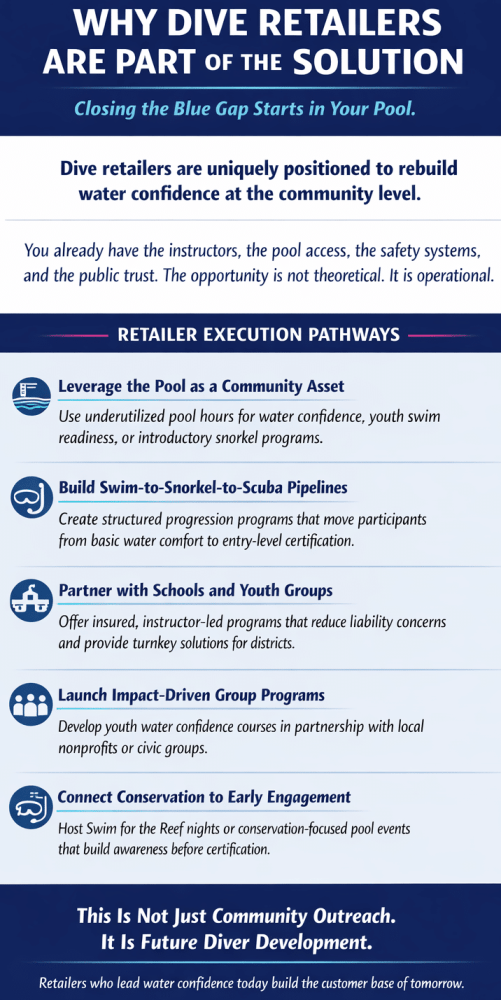
Strategic Industry Solutions – The Dive Retailer as the Bridge: The cycle of fear doesn’t just endanger lives – it limits the growth of the diving industry. If we wait for school systems to change, we will lose another generation. The dive retailer is the natural “Blue Gap” bridge. Retailers are the risk-management experts, the equipment specialists, and the gatekeepers to the underwater world. To transform the “Barrier of Blue” into a gateway of opportunity, dive retailers can implement these strategic solutions:
The Pool as a Community Safety Asset: Reposition your quiet pool hours as water confidence sessions or youth swim readiness programs. Utilizing your facility in this way transforms your shop into a vital community resource.
Paid Advertisement


“Swim to Snorkel” Pathways: Not every child is ready for a tank on day one. Create low-barrier pathways: Swim Readiness > Snorkel Skills > Ocean Discovery. This builds a long-term relationship with the customer from their very first splash.
Partner With Schools (Don’t Wait on Them): Schools fear water because they lack specialized staff. Approach districts as the solution – offer instructor-led supervision and insured instruction models that take the administrative burden off their shoulders.
Rebuilding Access: Break the generational fear cycle by ensuring your staff and marketing reflects the diversity of the community you want to attract. Culturally welcoming beginner programs turn “local shops” into inclusive community hubs.
Impact-Driven Group Programs: Launch youth water confidence courses in collaboration with local organizations (YMCA, Boys & Girls Club). Ending a program with a snorkel day or an ocean field trip cements their connection to the aquatic world.
The Conservation Pipeline: Connect the pool to the reef early. Host “Swim for the Reef” nights or create a retail “Sponsor Wall” where laps swum in the local pool fund coral out-planting initiatives in the Caribbean.
Proactive Community Engagement: Host community swim nights to introduce new families to your facility. By creating a clear, visible Swim > Snorkel > Scuba pathway, you make the journey into diving intuitive and accessible.
The ROI of Empowerment vs. Avoidance: The contrast between the traditional Avoidance-Based Model and the CARES Empowerment Model reveals a superior Return on Investment (ROI) driven by proactive risk management. While the Avoidance-Based Model leaves vulnerable groups at a high risk for drowning, the Empowerment Model significantly reduces this risk, saving lives and eliminating the potential for the highest-cost tragedies.
From an insurance perspective, avoiding the water may offer short-term flatlining of premiums, but the CARES model’s moderate initial investment in safety infrastructure creates long-term systemic cost reductions. This shift is most evident in policy costs per incident, were avoidance carries the potential for multi-million-dollar liability lawsuits and catastrophic reputational damage, the Empowerment Model focuses on minimal-cost preventative training. The most significant ROI is in preventing the unquantifiable – the loss of human life and the degradation of the environment.
A Call to Action – Reclaiming the Water; The ocean belongs to everyone, but until every child is water-safe, that promise remains unfulfilled. The most powerful tool for changing the narrative is representation. The CARES philosophy emphasizes recruiting and training instructors and marine scientists who reflect the diversity of the students being served. When a young person from a traditionally marginalized background sees a scientist or a lifeguard who looks like them, the psychological barrier of the “Blue gap” begins to crumble.
It is time for schools to stop managing liability and start managing education. It is time for communities – and specifically the dive industry – to reclaim the water as a place of safety, access, and stewardship. By turning our pools into classrooms for mastery, we aren’t just selling gear or certifications. We are ensuring that the heart of the ocean continues to beat in the lungs of the next generation.
The ocean has been exhaling for us since the beginning of time. It is time for us to step into the water and help it catch its breath.

Click here to read the full article on our Flippingbook platform!
More from This Issue:
FEBRUARY 2026 ADVERTISING PARTNERS







RECENT ISSUES



MAGAZINE TOPICS