


WYLAND WITH RACHEL, SCULPTURE AT MARKER 88 IN THE FLORIDA KEYS 
WYLAND IN FRONT OF HIS SCULPTURE IN ISLAMORADA IN THE FLORIDA KEYS 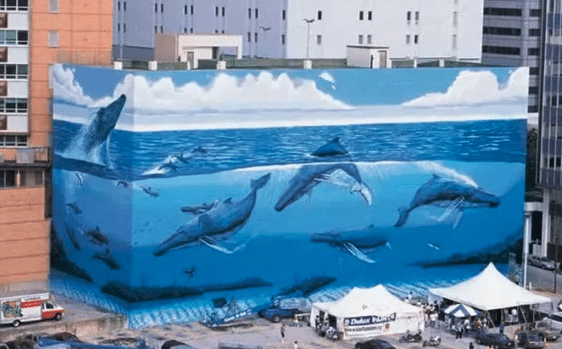
DOWNTOWN DALLAS, TEXAS, WYLAND WALL AT 505 N AKARD ST.

Loss of iconic “Whaling Wall 82” raises questions about public art, ocean conservation messaging, and the visibility of marine life in urban communities
DALLAS, TEXAS — One of downtown Dallas’ most recognizable ocean conservation murals has been painted over, sparking concern from marine artist Wyland, public art supporters, and members of the conservation community.
The mural, known as “Ocean Life” or “Whaling Wall 82,” was painted by internationally known marine life artist Wyland in 1999 on the side of a building at 505 North Akard Street in Dallas. The large-scale mural featured humpback whales, dolphins, and ocean imagery, bringing a powerful marine conservation message into the heart of a landlocked city.
The wall is now being covered as part of preparations connected to the FIFA World Cup 2026, with Dallas scheduled to host nine matches during the tournament. The change has generated public reaction in Dallas and beyond, as many residents and ocean advocates view the mural as more than decoration. For nearly three decades, it served as a reminder that ocean conservation is a global responsibility, even far from the coast.
“Dallas is landlocked. The mural of humpback whales and dolphins that I painted in 1999 makes people think about connection with the oceans. This is about saving art in America,” Wyland said from his studio in Islamorada, Florida.
For the diving industry, the loss of the mural is especially meaningful. Wyland’s public art has long helped connect people to whales, dolphins, coral reefs, and the ocean environment. His murals have brought marine life into cities, schools, public spaces, and communities where many people may rarely see the sea, but where daily decisions still affect the health of the planet’s waters.
Wyland said he and the Wyland Foundation were not notified before the mural was painted over. He has also raised concerns over artist rights and the protection of public art under the Visual Artists Rights Act. According to Wyland, any funds recovered through legal action would be directed to charities supporting conservation efforts.
“This is about all artists and public art,” Wyland said. “Lose this and all artists lose.”
The controversy highlights a larger question for cities preparing for major international events: how can communities welcome new visitors and celebrate global sports while also preserving cultural landmarks, public art, and environmental messages that already belong to the community?
The North Texas World Cup Organizing Committee has reportedly said that part of the original mural will be preserved as a tribute, while new artwork is intended to build excitement for the upcoming tournament. Still, the removal of the whale mural has intensified discussion about how decisions are made when public-facing art, private property, commercial campaigns, and civic identity intersect.
Wyland has said he does not intend to repaint the mural.
“I will not re-paint it, never,” he said.