

sponsors in this article: Explorer Ventures Liveaboards, DEMA
A Retailer’s Guide to North Florida Wrecks

THE FLORIDA PANHANDLE is sometimes referred to as The Emerald Coast because the combination of clear Gulf water and brilliant white sand often produces a distinctive hue. It is an area tied to the water: fishermen, water sports enthusiasts and boaters flock to these waters throughout the year. For scuba divers, there is a wealth of diving opportunity beneath these waves. And currently, there is a lot of buzz around an anticipated ship sinking that will be a game changer for the entire region.
The famous luxury liner SS United States is being readied for deployment as an artificial reef off the Destin-Ft. Walton area of the Florida Panhandle. The 990-foot liner, once known as America’s Flagship and owner of the speed record for an Atlantic crossing that remains to this day, has until recently been berthed in a boatyard in Mobile, Alabama as it was prepared for its sinking. The date of the sinking remains uncertain, but early 2026 is the latest estimate.
Dive shops and charter boat captains are eager to see the vessel deployed underwater. Once sunk, the SS United States will become the largest artificial reef, outdoing the nearby USS Oriskany. The local dive industry expects this to be a boon to their business; some are planning to purchase additional boats to accommodate the anticipated demand for dives to the vessel and others are expecting daily dive trips to the site.

“It has already attracted attention from around the world, and we expect it will boost the local dive industry and the economy in general,” says Savanna Christy, owner of ScubaTech in Destin, Florida.
The addition of the SS United States to these Gulf waters is sure to catapult this area to a premier and much sought after dive destination. Now is the time for dive shops looking to get in on the action to begin planning trips to the area.
Diving the waters of the Gulf of Mexico (or Gulf of America) involves shipwrecks. A trip to the area to explore the SS United States once it is sunk would benefit from including dives to many of the other wrecks in the area. Indeed, there are wrecks to satisfy every level of diver experience, ranging from those that are relatively shallow and easy to navigate to deep water, technical dives on massive warships.
The SS United States will be sunk off Destin, Florida. But a little over an hour to the east is Pensacola, home of the USS Oriskany.
The USS Oriskany, a 911-foot-long aircraft carrier, was sunk on May 17, 2006, 22.5 nautical miles southeast off Pensacola Pass at a depth of 212 feet. At the time of her sinking, she was the first naval warship and largest artificial reef ever to be intentionally sunk in U.S. coastal waters.
The “Mighty O,” as she is nicknamed, is a vessel with a storied history. She was an Essex-class aircraft carrier built shortly after World War II. She earned two battle stars for service in the Korean War and five battle stars for service in the Vietnam War. After completing 25 years of service, she was decommissioned in September 1976. The vessel was subsequently sunk in a joint effort between the U.S. Navy, the Florida Fish and Wildlife Conservation Commission (FWC), and Escambia County in Florida.
The top of the ship’s island comes into view at a depth of around 65 feet. An American flag, along with a POW-MIA flag and a United States Marine Corps flag, are tied to the top of the superstructure and waving in the brisk current.
Paid Advertisement

After 2 decades of submersion, the wreck is covered in marine growth. Shellfish, corals and algae obscure much of the original metal. Robust schools of tropical fish swirl around the superstructure, evidence that the intention of the artificial reef program has been met. We first explored the upper levels of the island before descending to the next levels in the direction of the stern, an observation bridge at about 110 feet. Here, orange and yellow cup corals adorn the wreckage and delicately frame the entrances of windows, doorways and hatches.
The wreck of the USS Oriskany is enormous and most of it lies beneath the range of recreational scuba. The flight deck, for instance, is at around 140 feet, the hangars around 165 feet and the sand is 210 feet or deeper in spots. Most divers visiting this wreck only explore the superstructure of the carrier’s island, but even just this area provides enough adventure for many visits to this grand wreck!
There are several dive charter boats in the area as well as dive shops for tanks, weights and other equipment rentals. Divers, or trip organizers, should contact the dive shops in advance to make sure tanks and weights are available for the days you book your dives. In this area, the dive boats do not supply tanks and weights. For our trip to the Oriskany, we worked with Dive Pros, a dive shop in Pensacolajust a PNG and the Niuhi Dive Charter dive boat.
After exploring the USS Oriskany, we moved our base of operations about 45 miles to the east to the bustling seaside town of Destin, Florida. With unimaginably white beach sands and easy access to the Gulf waters, Destin is fast becoming a popular destination on the Panhandle.
With the imminent sinking of the SS United States off Destin, this area is poised to become a diving hotspot. Our objective was to sample some of the existing wrecks that have been intentionally sunk off Destin. We wanted to dive shallower, inshore wrecks as well as wrecks further offshore. All these wrecks would make interesting additions to a well-crafted dive itinerary for divers coming to dive the SS United States.
Our first dive was to the wreck of the Miss Louise, a sunken push tugboat lying in around 60 feet of water only a few miles out of the Destin Pass. The ship was put down in 1997 and is home to a wide variety of marine life.
The Miss Louise is a perfect dive for all levels of divers and is a great wreck to explore to become acquainted with Gulf diving.
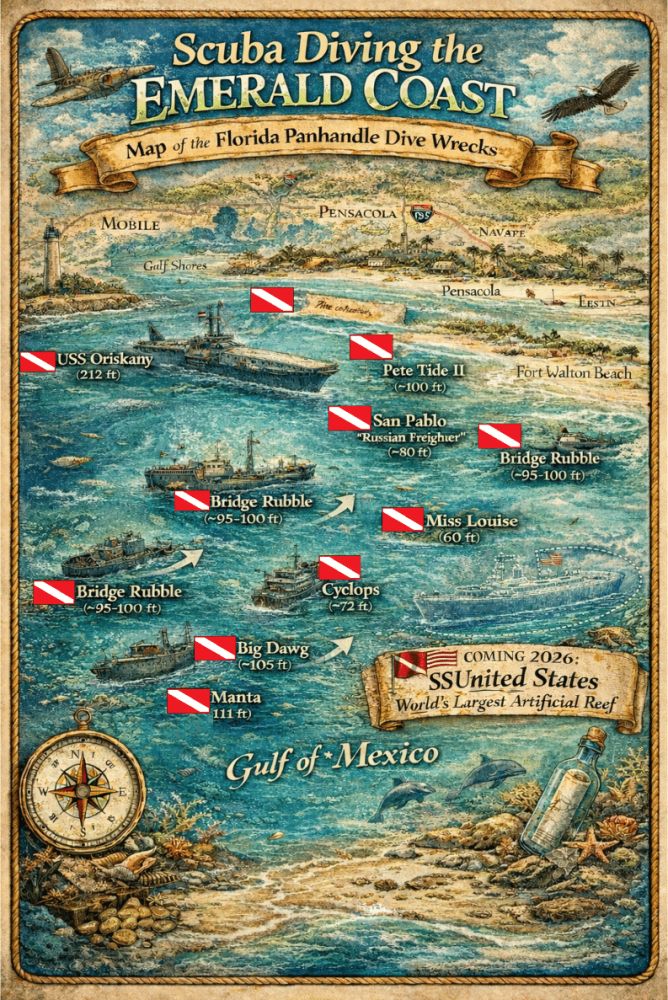
Our next dive was to the Cyclops, a 105-foot decommissioned offshore supply vessel that was used by the oil industry while it was in service. The Okaloosa Coastal Resource Team sank the Cyclops on April 18, 2023, as another addition to the trail of intentional wrecks along the coast. The Cyclops settled to the bottom at 72 feet upside down and remains that way today.
After diving on these inshore wrecks, it was time to head further offshore.
Our first offshore wreck was the wreck of the Manta, sunk in January of 2023, 16 miles southwest of the Destin Pass in 111 feet of water. The Manta, a 190-foot vessel used for oil exploration out of Louisiana, has some intriguing penetration opportunities along with long corridors along the side rails perfect for exploration. Divers can reach the top of the wreck in about 70 feet of water and there is plenty to see at those depths for divers who want to avoid the time penalties of diving deeper.
Next, we visited the watercraft “PL-94-9301,” better known as the “Big Dawg,” another of Destin’s offshore wrecks. Sunk in May of 2021, the Big Dawg was a 93-foot steel Air Force Parachute Water Survival School training vessel.
On our dive, we experienced clear water with about 50-foot visibility. As with all the wrecks we explored in the Gulf, water temperatures were extremely high at the surface but dropped off in stages, with thermoclines around 40 and 60 feet. Bottom temperatures were in the low 70s Fahrenheit. On the Big Dawg, we saw Amberjack, schools of snapper, an occasional butterflyfish and, hanging out near the stern, another curious Goliath Grouper.
The Big Dawg sits in 105 feet of water but has several decks and divers can reach the wreck at around 60 feet. Because of its profile, the wreck is suitable for all levels of diver.
In Destin, we utilized ScubaTech as our base of operations but there are several alternatives in the area.
The artificial reef program in Florida is one of the most active in the world. Since the 1940s, more than 4,422 planned artificial reefs have been deployed off Florida’s coasts. The Florida Panhandle alone has over 430 such reefs, many of these being decommissioned and intentionally sunk vessels. Clearly, our small sample could never inventory all these sites…it’s a challenge that could keep divers coming back for generations. Regardless of the skill level of your divers, there’s a wreck site suitable for them in these waters.
Paid Advertisement


Click here to read the full article on our Flippingbook platform!
Watch the interview on Level Up:
read < Previous Article