




For immediate release
4 November 2025
Kew, London / Stranraer, Scotland
Royal Navy Armed Merchant Cruiser HMS Bayano conclusively identified 110 years after being sunk by German submarine U-27 in 1915.
4 November 2025: Today, a team of 7 technical divers from the community-led initiative ProjectXplore publish their Report formally identifying the wreck of HMS Bayano, a First World War Armed Merchant Cruiser (AMC) torpedoed by the German submarine U-27 on 11 March 1915, which sits at a depth of 106m in the North Channel. The ship, lost with 198 officers and men, has not been conclusively identified until now.
The identification follows months of extensive archival research at the UK National Archives, Kew, and Glasgow City Archives, and a focused offshore sonar survey and dive operation out of Stranraer on 12 and 13 October 2025 aboard the dive vessel MV Aquaholics 5, thanks to skipper Richard Lafferty and crew Timmy Donaghy.
The location of the wreck sits just 1.7nm from the position indicated by surviving Royal Marine, Private Arthur Craze, and 2.4nm from the position indicated by U-27’s Kriegstagebuch (“KTB” or war diary) maintained by Kapitänleutnant Wegener.
“We are confident that we have conclusively identified the wreck of HMS Bayano because she is the only British Armed Merchant Cruiser sunk in the First World War armed with two 6-inch (152 mm) guns, and the wreck shows both of them in the expected positions,” said Leo Fielding, diving co-organiser, ProjectXplore.
What the divers found
The wreck lies in the North Channel between Scotland and Northern Ireland at a seabed depth of 106 metres with the shallowest point at 84 metres. The vessel lies bow NNW / stern SSE with a 20-degree starboard list and rises over 15 metres above the seabed in places.
On 12-13 October, the team:
• ran a towed side-scan sonar (SSS) survey to confirm the target’s size and profile;
• dived the site using closed-circuit rebreathers;
• photographed and measured the two 6-inch guns, one forward and one aft;
• documented features consistent with an Elders & Fyffes-built merchant steamer converted to an AMC;
• confirmed dimensional data (~126 m length, ~16 m beam) consistent with those of HMS Bayano.
Photo credit: Dan McMullen
Crucially, the divers photographed the stern 6-inch gun and measured the internal diameter of the muzzle, while SSS data confirmed a barrel length of ~6.8 m, matching the BL 6-inch Mk VII naval gun specified for HMS Bayano during her conversion. This two-gun configuration is the key discriminator.
Photo credit: Leo Fielding
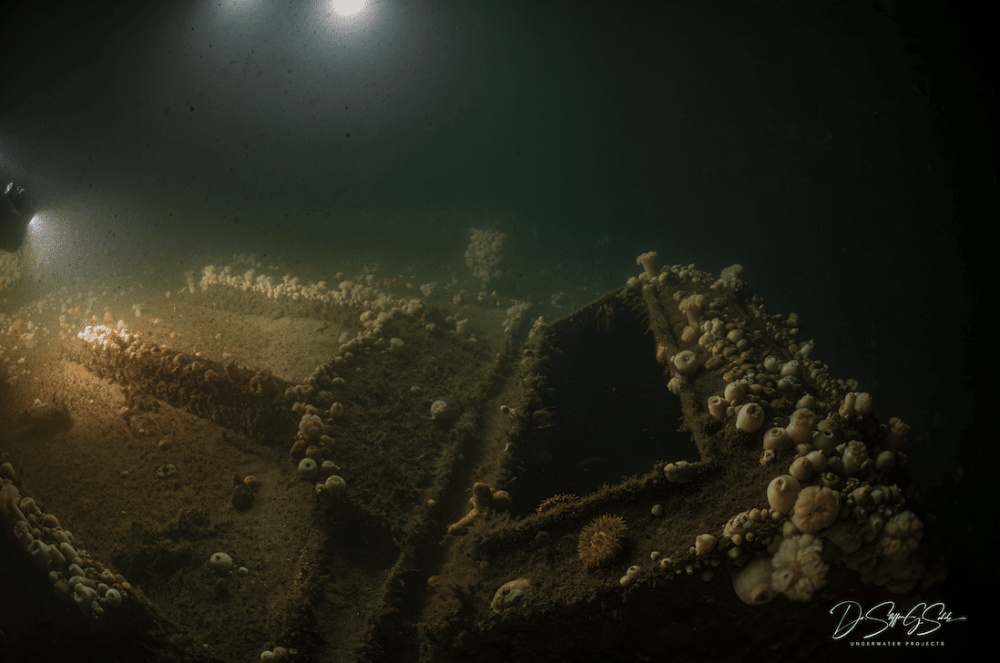
Photo credit: Dr Steffen Scholz
National Archives and Glasgow Archives evidence that:
• Imperial German Navy records: U-27’s war diary (Kriegstagebuch, KTB) gives a sinking position of 55° 05′ N, 005° 23.5′ W, consistent with the wreck’s plotted position.
• British survivor testimony: Royal Marine Arthur Craze told the Portsmouth Evening News in March 1915 that Bayano was torpedoed about 18 miles south-west of Ailsa Craig; the discovered wreck is 1.7 nautical miles from Craze’s position.
• Reports such as the Western Times (15 March 1915) described the position where survivors were recovered as c. 18 miles NE by E from Black Head and 8 miles WSW of Corsewall Point. The wreck is 2.4 nautical miles from U-27’s own recorded position, well within 1915 positional error.
The team then identified bathymetric data that suggested a large object in the general area indicated by the historical records, which prompted the October dive operation.
“The identification is not based on one photograph but on a series of mutually reinforcing indicators like the gun size, location, the dimensions, the single-funnel merchant layout, the refrigeration plant, the railing pattern, the stern form and the historical positions,” said Dr Steffen G. Scholz, technical diver and underwater photographer.
Photo credit: German Naval Archive, Kiel
HMS Bayano
Built as a refrigerated fruit carrier for Elders & Fyffes and later requisitioned in 1914 and armed as an AMC.
Sunk on 11 March 1915 by U-27 (Kapitänleutnant Bernd Wegener) in an early phase of intensified German submarine operations around the British Isles.
198 lives were lost, making it a high-casualty loss in UK home waters.
The wreck bears witness to the vulnerability of hastily converted merchant ships employed on blockade and patrol duties in the North Channel.
“Every detail such as the guns, railings and engineering speaks of a working warship and of the men who served aboard her. This was a moment of discovery and of remembrance,” said Daniel McMullen, ProjectXplore diver and co-organisers.
“At that depth, conditions are demanding and time on the bottom is short, but the site is remarkably intact, which makes it an exceptional piece of underwater heritage,” added Alexandra Pischyna, ProjectXplore diver.
“To stand witness to HMS Bayano again after 110 years is an immense privilege. We hope this work honours her crew and preserves their story for future generations,” said Joe-Colls Burnett, ProjectXplore diver.
Protection and conserving maritime history
The team has produced a formal report documenting the position, archival sources, dive observations, and photographic evidence.
Project report: https://drive.google.com/drive/folders/1RGizRm0Ao1sOENY1kaElx3pH89CX8y_F
“We got clear, and were about 18 miles north-west of Ailsa Craig rock when we were struck…I said to the boys, ‘That’s a bullseye,’ as I heard the crash of the explosion. I was asleep in the State apartments on the promenade deck, and we all rushed on deck as quickly as we could. As I turned out I put on my trousers and a serge [uniform]. I went on to the hurricane deck, above the upper deck, and we tried hard to get the boats out, but the ship was going down by the bows so fast that we could not manage it. The captain was on the deck near us, having walked from the bridge, and I heard him say to some of those near me, ‘Good lad, save yourself.’ He tapped several on the shoulders and said ‘Look after yourselves, boys.’ The torpedo hit us directly under the bridge on the starboard side, and the fore part of the ship seemed to be blown up. Those below could have had no chance, and must have been drowned like rats in a trap, for the water was rushing in with a fearful roar. I could never have believed that under such circumstances everything could have been so very orderly and quiet. Men were moving about as unconcerned as if nothing had happened and they were just doing their ordinary duty. I remained until the sea took me away from the ship. The biggest part of her was down by the bows. I can remember quite plainly the sea coming right over me and covering me up. I pushed out with my legs, swimming on my back. The life-collar, we call them Zeppelins, was in my pocket deflated, but I did not trouble about that, as I am a very strong swimmer. The last thing I saw of the ship was the propellers up in the air, perfectly still.”
Royal Marine, Arthur Craze, HMS Bayano survivor
-ENDS-
Notes to Editors
Press contact
Leo Fielding: lbmcfielding@gmail.com +44 (0)7809 512 613
Dan McMullen: dan.mcmullen246@yahoo.co.uk +44 (0) 7538 011 433
Available for interviews: Leo Fielding (UK), Dr Steffen G. Scholz (DE), Dan McMullen (UK), Alexandra Pischyna (DE), Joe-Colls Burnett (Spain).
Hi-Res Images: https://drive.google.com/drive/folders/1RGizRm0Ao1sOENY1kaElx3pH89CX8y_F
HMS Bayano Key dates
• 11 March 1915: HMS Bayano torpedoed by U-27 in North Channel, c. 198 fatalities.
• September to October 2025: archival narrowing of target box (Kew, Glasgow).
• 12 and 13 October 2025: departure from Stranraer, Scotland. Side-scan and CCR closed-circuit rebreather dives from MV Aquaholics 5; wreck documented at 106 m.
• 4 November 2025: The identification of HMS Bayano – Courage on the Clyde published.
HMS Bayano Location
• North Channel, between Scotland and Northern Ireland
• Seabed: ~106 m
• Orientation: bow NNW / stern SSE
• List: ~20° to starboard
• Height above seabed: up to 15 m
Identification features
• Two 6-inch (152 mm) BL Mk VII guns present (fore and aft)
* Dimensions: ~126 m × 16 m
• Single funnel, two masts (collapsed)
• Machinery consistent with early 20th-century refrigeration systems, including insulated piping and compressor remnants.
• Five-bar safety railings on promenade deck
• Elliptical transom profile
• Damage pattern consistent with starboard-side torpedo hit “under the bridge” as reported by survivor Royal Marine Arthur Craze
• Final wreck position within 1.7 nm of survivor position and 2.4 nm of U-27 KTB
Who are ProjectXplore
Welcome to ProjectXplore! We are a Global Underwater Explorers project passionate about understanding and conserving maritime history. We aim to locate, dive, identify and document historically significant shipwrecks in offshore locations all around the UK. More information can be found on our socials: https://www.facebook.com/profile.php?id=61566542670977 andhttps://www.instagram.com/projectxplore.gue/.
What is our mission?
ProjectXplore is committed to three main goals that guide everything we do:
1) education: to document historically significant uncharted shipwrecks to better understand their design and the circumstances of their loss;
2) conservation: to understand the shipwrecks’ condition today and how it is changing so that as far as possible our maritime history can be properly conserved for future generations;
3) remembrance: to commemorate the sailors who lost their lives at sea and to provide insights into their stories and experiences.
ProjectXplore is a not-for-profit project, and its team members are volunteers: https://www.gofundme.com/f/discover-and-conserve-maritime-history