

By John Christopher Fine

DR. SALLY BAUER (RED) WITH JEFF CROFT (WHITE HAIR GLASSES) SHOWING HDM MEMBERS SARAH & BRAD KING CROFT MEMORABILIA 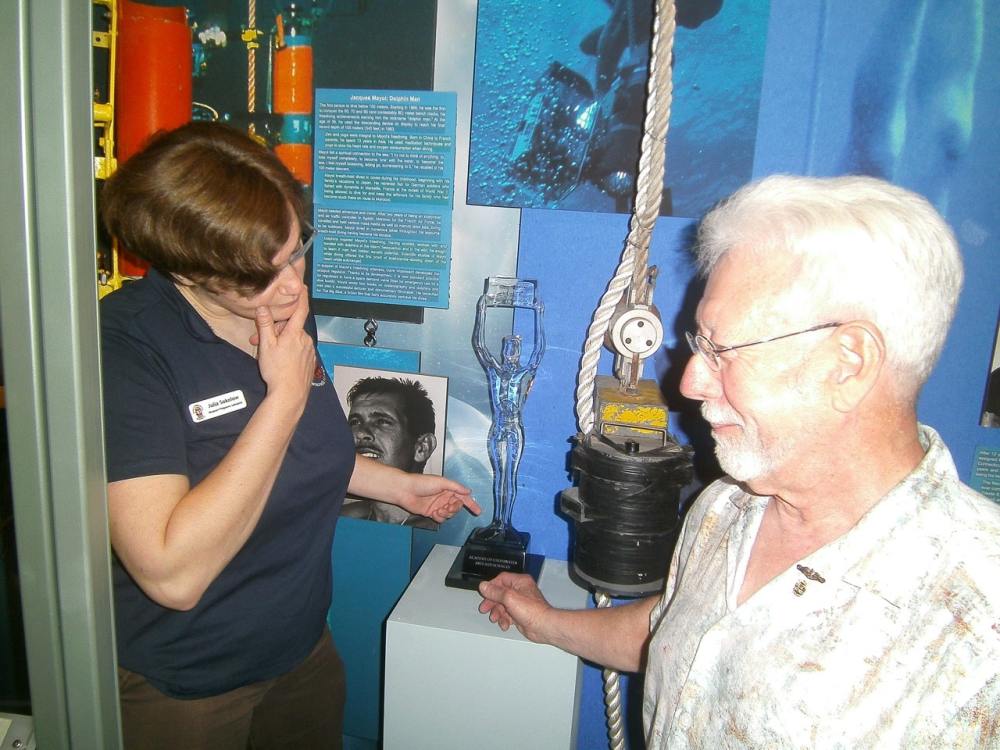
CROFT’S NOGI STATUETTE IN THE FREE DIVING DISPLAY 
DR. SALLY BAUER (RED), JULIA SOKOLOW, JOSH THACKER, KAREN CROFT, JEFF CROFT WITH NOGI PRESENTATION 
DR. SALLY BAUER & JEFF CROFT WITH NOGI DONATED TO FREE DIVING DISPLAY
The History of Diving Museum in Islamorada, Florida, recently hosted a special event honoring the life and legacy of Robert A. “Bob” Croft, a U.S. Navy submariner, diving instructor, and pioneering breath-hold diver whose accomplishments helped shape early understanding of human performance underwater.
Croft’s son, Jeff Croft, and his wife, Karen, traveled from Pennsylvania to the Florida Keys to pay tribute to his late father and present several important pieces from the family collection to the museum. The donation included Croft’s 2016 NOGI statuette, awarded by the Academy of Underwater Arts and Sciences, along with special contact lenses worn by Croft and other memorabilia connected to his remarkable diving career.
Born July 19, 1934, Bob Croft joined the U.S. Navy as a diver in 1951. During his naval career, he served aboard seven submarines and two experimental diving vehicles. The Navy soon recognized his extraordinary breath-holding ability, timing him underwater for 6 minutes and 40 seconds. That discovery led to Navy-supervised testing in which Croft was connected to instruments that recorded his heart rate, breath samples, and performance during deep breath-hold dives.
On February 8, 1967, Croft set a record with a breath-hold dive to 212 feet. He broke that record the following year with a dive to 217 feet, then surpassed his own world record in 1969 by diving to 240 feet. After reaching depth, he pulled himself hand over hand up a line, completing the dive in 2 minutes and 28 seconds.
Although Croft’s records have since been exceeded, his achievements were groundbreaking. He was among the first divers to reach such depths under medical supervision, helping researchers better understand the body’s response to deep breath-hold diving.
Jeff Croft shared memories of his father with the audience, describing both his Navy discipline and his gentle personality at home. He also explained his father’s “air packing” technique, in which Croft used his tongue to force additional air into his lungs to increase capacity. This unusual ability helped prompt Navy doctors to study him more closely.
After his record-setting dives, Croft continued his service as an instructor in submarine escape techniques at the Navy base in Groton, Connecticut. He later held several diver training positions and continued giving presentations about diving throughout his life.
Bob Croft died January 9, 2026, at age 91.
The event included a film about Croft’s deep dives and experimental work. Jeff Croft said the family wanted to ensure that his father’s accomplishments would continue to educate and inspire future generations. Through the family’s donation, the History of Diving Museum has expanded its ability to tell the story of one of diving’s true pioneers.